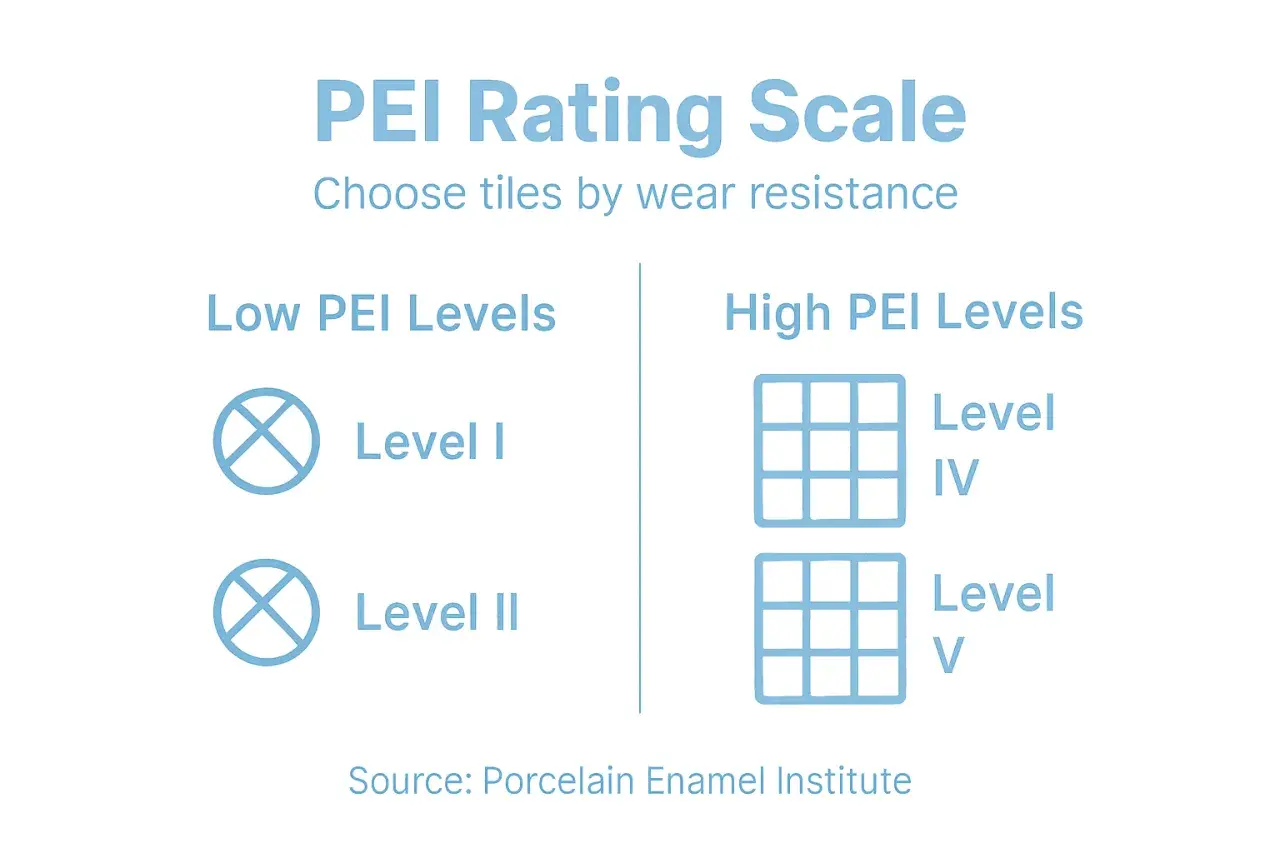
Bathroom and floor tile choices get complicated fast because one number rarely tells the whole story. When I evaluate a tile PEI rating, I treat it as a wear test, not a universal quality score, which is a much better way to think about how a tile will actually live in a room. In this guide I break down what the rating measures, how to match it to bathrooms and other U.S. spaces, and which extra specs matter just as much when the surface gets wet.
What matters most when you compare tile wear ratings
- PEI describes visible surface wear on glazed tile, not slip resistance or overall quality.
- For most residential floors, PEI 3 is the practical baseline; PEI 4 or 5 makes sense when traffic is heavier.
- Bathroom floors should be judged with both wear and wet-floor safety in mind.
- Shower floors depend more on traction, tile format, and slope than on a high wear rating alone.
- Wall tile can often use a lower wear class because foot traffic is not the issue.
- Always confirm whether the tile is glazed or unglazed before you rely on the rating.
What the PEI rating actually measures
The PEI rating is shorthand for how well a glazed tile surface resists visible abrasion. The Tile Council of North America points out that people often use “PEI” as a habit, while the more exact standard language in ANSI A137.1 is visible abrasion classification. In plain English, the number helps me predict whether a tile will keep looking even and clean after shoes, grit, and repeated foot traffic start doing their work.
That makes the rating useful for floors, hallways, kitchens, and commercial settings, but it does not tell you everything you need to know. It does not measure slip resistance, chip resistance, break strength, or how well a tile handles water. I see the best results when PEI is used as one filter, not the only filter, because the real world always asks more from a floor than a single wear number can capture. Once that is clear, the next step is matching the class to the room instead of the catalog photo.
How I read the scale room by room
In U.S. retail specs, the scale is usually shown from 0 to 5, and the labels are often translated into simple traffic language. Manufacturers may phrase the categories a little differently, but the practical meaning stays close enough to use with confidence. For most interior residential spaces, class 3 is the point where I start feeling comfortable; for most commercial spaces, class 4 is where the conversation usually moves.
| Class | Common use | What it means in practice |
|---|---|---|
| 0 | Wall use only | Decorative surfaces with no foot traffic. Fine for backsplashes and wall accents, not for floors. |
| 1 | Very light residential | Best for areas with minimal wear and little tracked-in grit. I would keep it out of busy floor zones. |
| 2 | Light residential | Works in low-traffic interiors and many wall applications. Good for calm spaces, not entry-style wear. |
| 3 | General residential | A solid baseline for most homes, including many bathrooms, kitchens, halls, and family rooms. |
| 4 | Heavy residential or light commercial | Better when grit, shoes, and constant use are part of daily life. This is where busy households often land. |
| 5 | Heavy commercial | Chosen for spaces that work hard every day, such as high-traffic retail, lobbies, and similar environments. |
That table is helpful, but I still ask one extra question: how dirty will the traffic be? A lightly used hallway and a mudroom-style entry can have the same number of steps, yet the one carrying sand and grit will punish the tile far more quickly. That is why the room matters as much as the rating, and it also explains why PEI is only one piece of the spec sheet.
Why PEI is not the same as slip resistance or hardness
This is where a lot of buyers get tripped up. PEI tells me about visible wear on glazed tile, but a bathroom floor also needs traction, and a kitchen floor may need scratch resistance and moisture performance. I separate those concerns so I do not overbuy in one category while underbuying in another.| Spec | What it tells you | What it does not tell you |
|---|---|---|
| PEI | How well a glazed surface resists visible abrasion | Slip resistance, impact resistance, or overall tile quality |
| DCOF | How much traction a tile provides under wet conditions | How quickly the surface will wear or scratch |
| Mohs hardness | Scratch resistance of the surface or glaze | Whether the tile is safe when wet |
| Water absorption | How porous the tile body is | Surface wear class or wet-floor traction |
For level interior floors that may be walked on when wet, I look for a DCOF of at least 0.42. That number does not make a surface foolproof, but it is a sensible baseline when you are choosing bathroom flooring in the United States. If the tile is polished, the room gets wet, or the people using the space include children or older adults, I become even more careful and I favor texture over shine. Once you separate wear from traction, the bathroom-specific decisions become much easier.
Where the rating matters most in bathrooms
Bathroom floors
For a typical residential bathroom floor, PEI 3 is usually a sensible starting point. If the room is a family bath, sits near an exterior door, or regularly picks up sand and grit from the rest of the house, I often move up to PEI 4 because the floor is effectively dealing with a harsher traffic pattern. In other words, the number does not have to be extreme, but it does need to match the way the room is actually used.
Shower floors
I do not choose shower floor tile by wear rating alone. In that area, small-format tile or mosaics often work better because they follow the slope more easily and create more grout lines, which helps with footing. Traction, cleanability, and proper drainage matter more here than chasing the highest PEI number. If the shower floor is flat, glossy, or oversized, the rating becomes much less reassuring in real life.
Read Also: Backsplash Backer Board - Do You Really Need It?
Walls and backsplashes
Wall tile is a different conversation. Because feet are not involved, the wear class can be lower without creating a problem, and the design choice can focus more on glaze quality, cleaning effort, color consistency, and visual texture. That is why a beautiful wall tile can be totally appropriate even when it would never make sense under a pair of shoes. Once you start looking at the room this way, the common buying mistakes become a lot easier to spot.Common mistakes that shorten tile life
- Using PEI as a slip test. A durable tile can still feel slick when wet, so wear and traction need separate checks.
- Putting wall tile on a floor. Decorative wall pieces may look right in the showroom but fail quickly under shoe traffic.
- Ignoring tracked-in grit. Sand and dirt create far more visible abrasion than bare feet or soft socks.
- Assuming porcelain automatically means floor-ready. Porcelain helps with density and moisture performance, but the finish and rating still matter.
- Forgetting whether the tile is glazed or unglazed. The rating is most relevant to glazed surfaces, so the product type changes how you read the spec sheet.
I see these errors most often in bathrooms connected to hallways, garages, or backyard entries, where the room is technically small but functionally busy. If the path to the bathroom is dirty, the tile in that bathroom gets treated like an entry floor whether you intended it to or not. That is why the final spec check matters so much.
The spec-sheet checks I would make before ordering bathroom tile
- Confirm whether the tile is glazed or unglazed.
- Check the PEI or visible abrasion class and make sure it fits the room.
- Verify the DCOF if the tile will be used on a wet floor.
- Look at the finish and decide whether matte or textured is safer than polished.
- Make sure the product is approved for floor use, wall use, or both.
- Plan for waste: about 10% extra is common for straightforward layouts, and 15% is safer for patterns, diagonal installs, or mixed-format work.
- Match the tile to the traffic source, not just the room name.
If I were specifying a bathroom tile package in 2026, I would usually start with PEI 3 for a normal residential floor, move to PEI 4 when traffic or grit is heavier, and treat DCOF as the real safety check for wet areas. That combination solves more problems than chasing the highest number on the box, and it usually produces a floor that still looks intentional after years of everyday use.