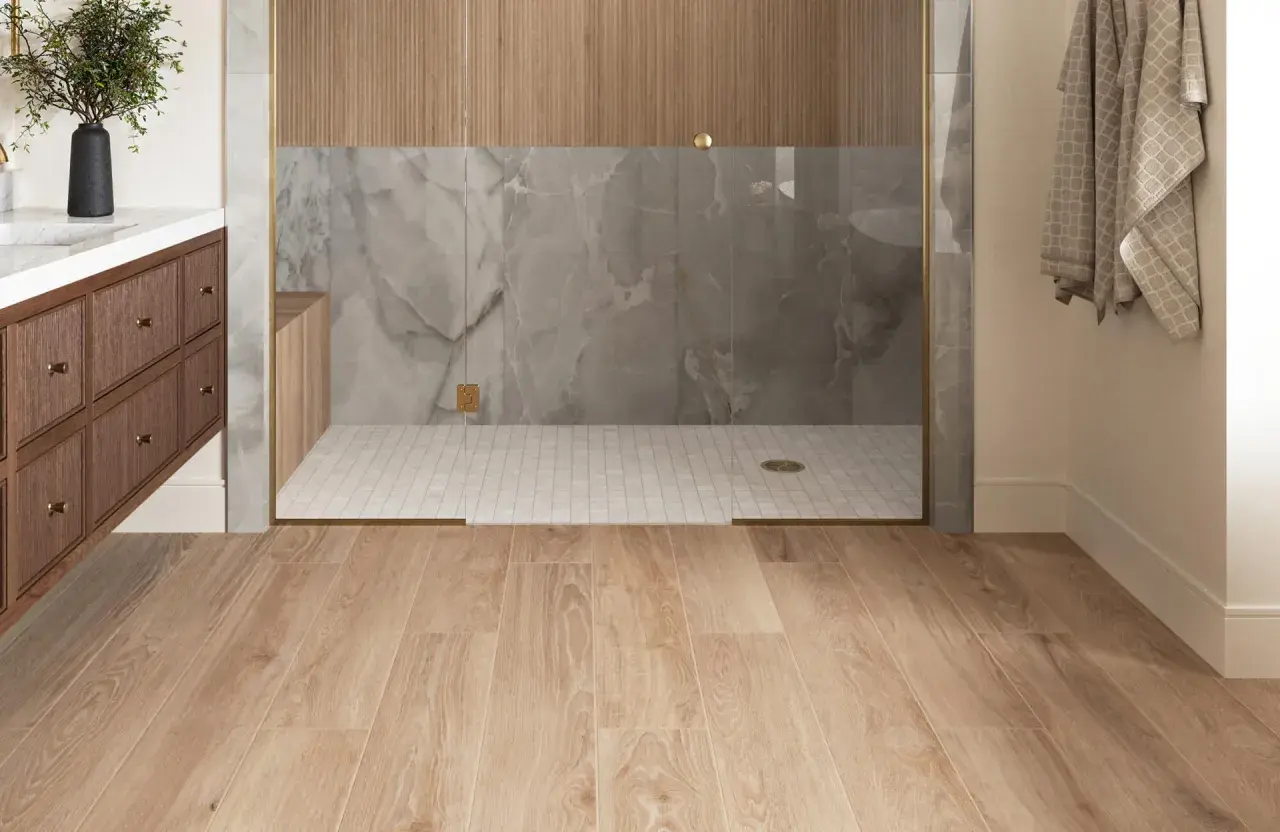
Wood-look porcelain solves a specific problem: you want the warmth of oak or walnut, but you need a surface that can handle water, pets, and daily abuse. The porcelain wood tile pros and cons are not subtle, and I think the decision becomes much easier once you separate performance from appearance. This guide breaks down where it excels, where it frustrates homeowners, what it costs in the U.S., and how to choose a version that looks intentional in a bathroom or any other high-traffic room.
The main tradeoffs at a glance
- Best for wet, busy spaces where hardwood would be a liability.
- Much easier to keep clean than real wood, and it does not need sealing.
- Harder and colder underfoot, so comfort is the main tradeoff.
- Large plank formats need a flat subfloor and a careful layout to avoid lippage.
- Material cost is only part of the budget, because installation can be labor-heavy.
Why this material keeps winning bathrooms and busy rooms
Wood-look porcelain keeps showing up in bathrooms, laundry rooms, kitchens, and entryways because it solves a real problem instead of just creating a pretty surface. It gives you the visual rhythm of a plank floor without asking you to baby it around spills, muddy shoes, or constant cleaning. Daltile's product guidance puts porcelain water absorption at 0.5% or lower, which is why I treat it as a serious wet-area floor, not a decorative compromise.
The appeal is practical as much as visual. If you want one flooring language to run from a hall bath into a laundry room and then through a mudroom, this material gives you continuity without the maintenance burden of wood. That is a big reason it keeps winning in U.S. homes, especially where bathrooms need to work hard every day.
There is still a tradeoff, though. The better it performs, the more you need to think about comfort, traction, and installation details. That is where the real judgment starts.
The strengths you actually notice after move-in
When wood-look porcelain is chosen well, the benefits show up in ordinary life, not just in the showroom.
- Moisture resistance: It handles splashes, steamy bathrooms, damp towels, and tracked-in water without swelling or cupping.
- Low maintenance: Regular sweeping and mopping are usually enough. There is no sanding, refinishing, or routine sealing schedule to manage.
- Scratch resistance: Pets, chair legs, and gritty shoes are much less of a threat than they would be on hardwood.
- Design consistency: You can carry the same floor finish across rooms and keep the house looking cohesive.
I especially like it in primary bathrooms and guest baths that need to feel calm but not precious. It gives you the visual warmth people want from wood, while still being honest about the reality of a wet room. In a busy household, that combination matters more than trendiness.
It also plays nicely with radiant floor heat, which is one of the smartest upgrades for a cold-tile bathroom. That matters because the next question is usually not whether it works, but what it gives up to get there.
Where wood-look porcelain disappoints people
The frustrations are real, and most of them come from what porcelain is, not from bad marketing.
It feels harder and colder than wood
This is the tradeoff people notice first after move-in. Porcelain does not have the softer step, warmer touch, or quieter sound of timber. If you like to stand barefoot in the bathroom for a long time, especially in a cold climate, a bare tile floor can feel unforgiving unless you add rugs or radiant heat.
The plank format exposes installation flaws
Long rectangular tiles are less forgiving than square tile. If the subfloor is not very flat, you can end up with lippage, which is the height difference between adjacent tile edges. The Tile Council of North America recommends tight flatness tolerances for large-format tile, and many installers reduce a traditional 50 percent offset to 33 percent or less on plank layouts to help control warpage and edge mismatch. In plain English, the better the installation, the more convincing the floor looks.
Cheap versions can look repetitive
Lower-end wood-look tile often repeats the same grain pattern too obviously, which kills the illusion. Glossy finishes can also make the floor look less like wood and more like decorative tile trying too hard. When I see a floor that reads as flat or fake, it is usually because the print variation, plank length, or grout color was not chosen carefully enough.
That is why I never look at the sample piece in isolation. I want to know how the floor will behave across the whole room, because the next issue is cost and how much of it belongs to labor rather than material.
What it costs in the U.S. and why labor matters more than people expect
For mainstream wood-look porcelain, I usually think in rough ranges rather than exact numbers. Material often lands around $4 to $12 per square foot, while professional installation commonly adds another $5 to $25 per square foot depending on prep, layout, and local labor rates. Once you include leveling, demolition, trim pieces, grout, and underlayment, the total installed price can move much higher than people expect.
| Cost item | Typical U.S. range | What pushes it up |
|---|---|---|
| Wood-look porcelain tile | $4 to $12 per sq ft | Longer planks, better printing, rectified edges, premium finishes |
| Professional installation | $5 to $25 per sq ft | Floor leveling, demolition, shower transitions, tight grout joints, complex patterns |
| Total installed project | $9 to $40+ per sq ft | Prep work, underlayment, trim, and the shape of the room |
The part that surprises people is how often labor outweighs the tile itself. Plank tile asks more from the installer than a simple square format does, so the floor can cost more even when the tile is not especially expensive. If your budget is tight, that is the first place I would stress-test the plan.
How it compares with hardwood and luxury vinyl plank
When people compare flooring options, they usually compare the look first and the maintenance second. I think the order should be reversed, especially for bathrooms.
| Material | Best for | Main drawback | My read |
|---|---|---|---|
| Wood-look porcelain | Bathrooms, laundry rooms, kitchens, entries | Hard, cold, and installation-sensitive | Best all-around choice when moisture is a real concern |
| Hardwood | Dry living spaces where warmth matters most | Does not love water or constant wear | Beautiful, but not my first pick for a bathroom |
| Luxury vinyl plank | Budget-conscious projects and softer-feeling floors | Less heat tolerant and usually less permanent | Good comfort value, but not as durable in the long run |
Hardwood still wins on natural warmth and acoustic comfort. LVP often wins on softness and easier DIY installation. Wood-look porcelain wins when the room is genuinely wet, messy, or high-traffic, and when you want a floor that can stay in service for a long time with minimal drama.
That comparison becomes even more useful once you look at the installation choices that decide whether the floor looks premium or merely busy.
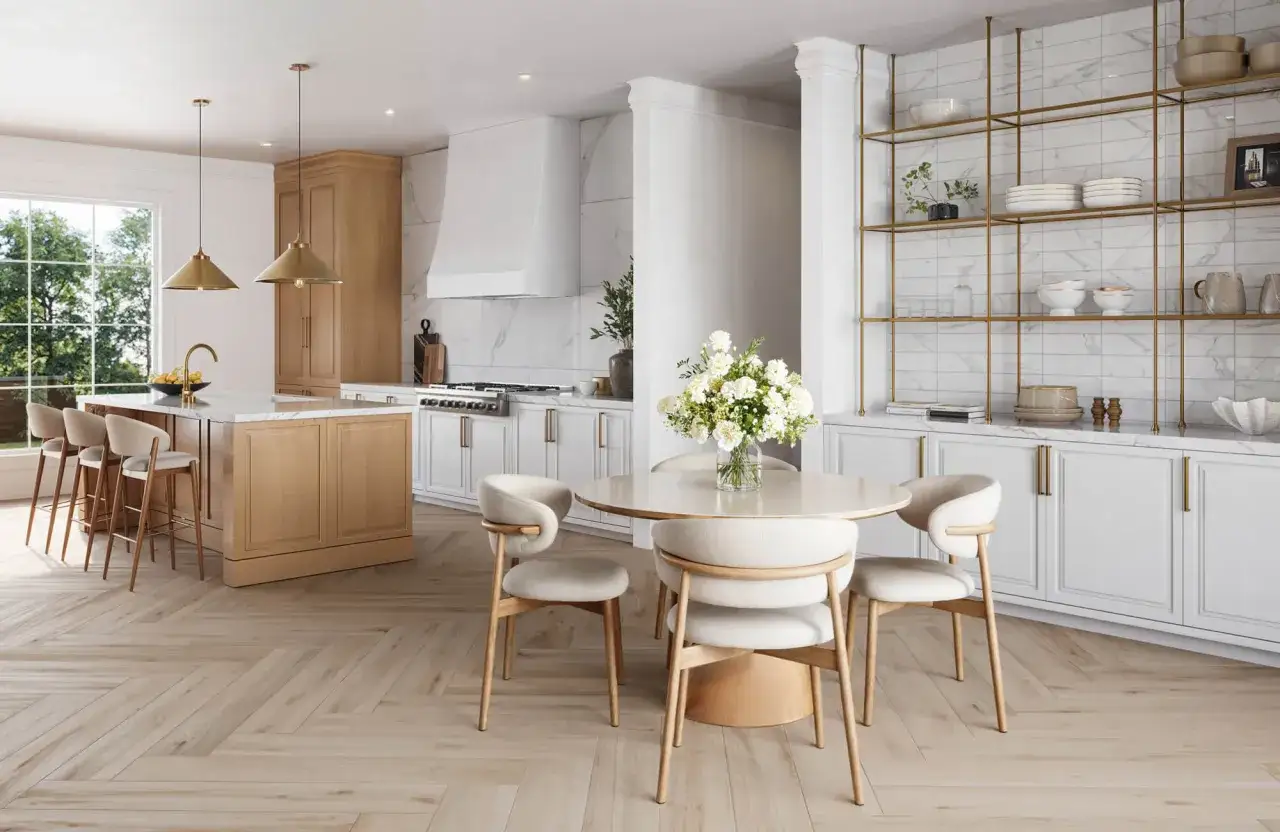
Installation choices that decide whether it looks premium or fussy
I think this is the section most homeowners underestimate. The tile sample may be beautiful, but the finished floor depends on details that are easy to get wrong.
Choose a layout the room can support
Very long planks can look fantastic in open areas, but they can overwhelm small bathrooms if the room is narrow or the floor is not perfectly flat. In compact spaces, I usually prefer a medium plank length with a restrained pattern rather than an ultra-long board that makes every error easier to see.
Match finish and grout to the room
For bathrooms, I usually prefer matte or lightly textured finishes over glossy ones. They read more like wood, feel less slick, and hide small marks better. Grout matters too. A close color match helps the floor feel continuous, but if the grout is too perfectly matched on a busy pattern, the floor can start to look flat instead of natural. The sweet spot is usually a tone that blends without disappearing completely.
Read Also: Clean Tile Cuts - Master Your Manual Tile Cutter
Check traction, not just style
For level interior floors intended to be walked on when wet, ANSI A137.1 uses a wet DCOF of 0.42 or greater as a reference point. That is useful, but I would not treat any single number as a guarantee of safety. In a bathroom, texture, drain placement, and how often the floor stays wet all matter too. If the tile is polished, I would be cautious. If it is matte with visible texture, I am far more comfortable recommending it.
My rule is simple: if the installer cannot explain the flatness requirements, offset choice, and grout plan in plain English, the project is not ready. The next question is when I would actually choose this material, and when I would pass on it completely.
When I would choose it and when I would pass
- I would choose it for bathrooms, laundry rooms, mudrooms, kitchens, and homes with pets or kids.
- I would choose it when moisture, scratching, and easy cleanup matter more than softness underfoot.
- I would pass if the room is a bedroom or lounge where warmth, quiet, and barefoot comfort are the top priorities.
- I would pass on a DIY install unless the subfloor is already very flat and the layout is simple.
- I would insist on a flat substrate, a realistic plank layout, and a grout color that supports the wood effect instead of fighting it.
If I were specifying a primary bathroom today, I would choose wood-look porcelain before hardwood almost every time. If the room needs to feel soft and quiet above all else, I would look elsewhere. The smartest decision is not the tile that looks most convincing in a sample board, but the one that fits the room, the installer, and the way you actually live.