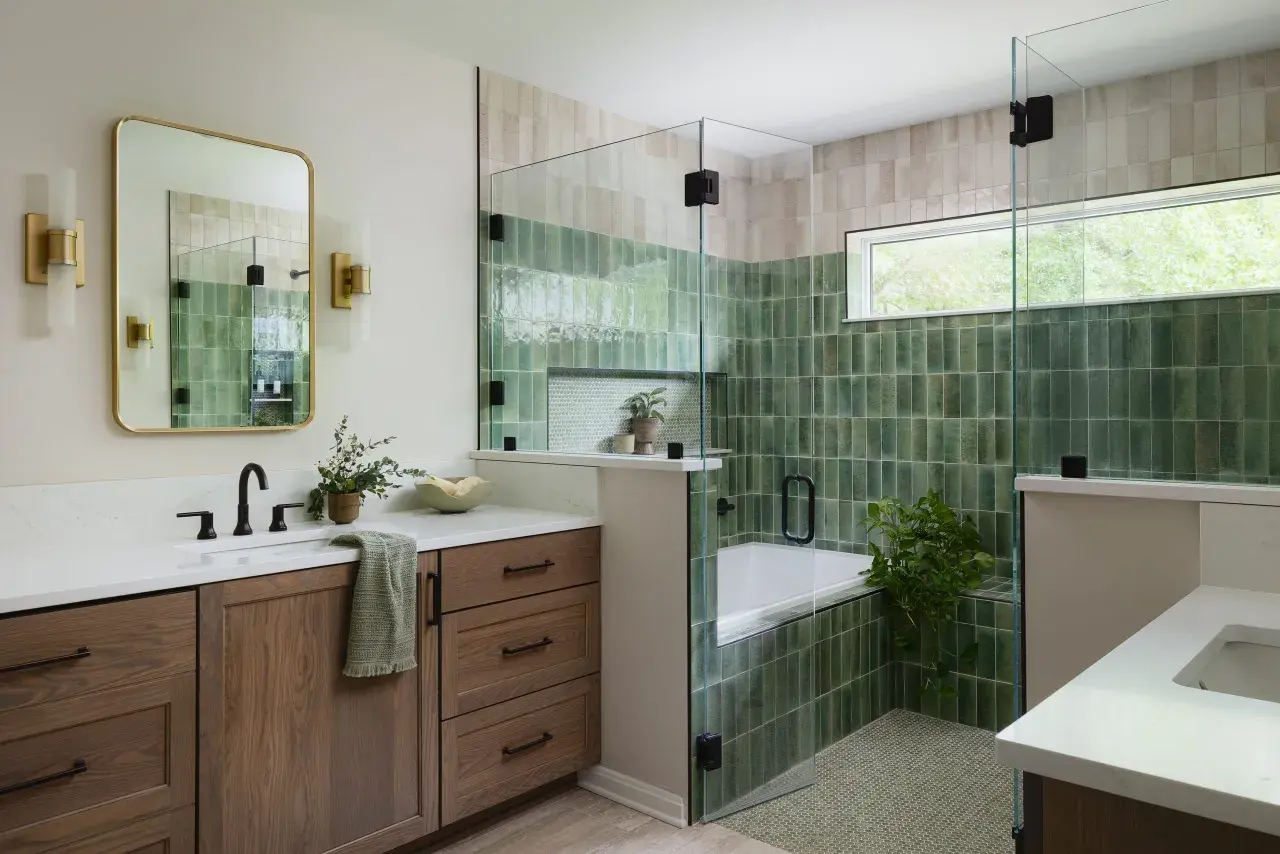
In practice, modern bathroom tiles work best when they do three jobs at once: they shape the room, handle moisture, and stay easy to live with. In 2026, the strongest looks lean warmer, calmer, and more textured than the cool gray bathrooms that dominated a few years ago. I’m focusing here on the tile choices that actually matter: material, finish, format, layout, grout, and budget.
These are the choices that matter most before you buy
- Porcelain is still my default for most bathroom floors and showers because it handles moisture and daily cleaning well.
- Large-format tile, usually any piece with one side longer than 15 inches, gives a cleaner and more modern feel, but only when the base under the tile is flat and the installer is careful.
- Matte or softly textured finishes are the safer choice underfoot; glossy tile is better saved for walls and low-splash zones.
- Warm neutrals, terrazzo looks, zellige-inspired texture, and stacked layouts are the most current directions in contemporary bathrooms.
- Budget matters as much as style: bathroom floor tile installation often lands around $5 to $17 per sq ft, with porcelain and premium stone pushing higher.
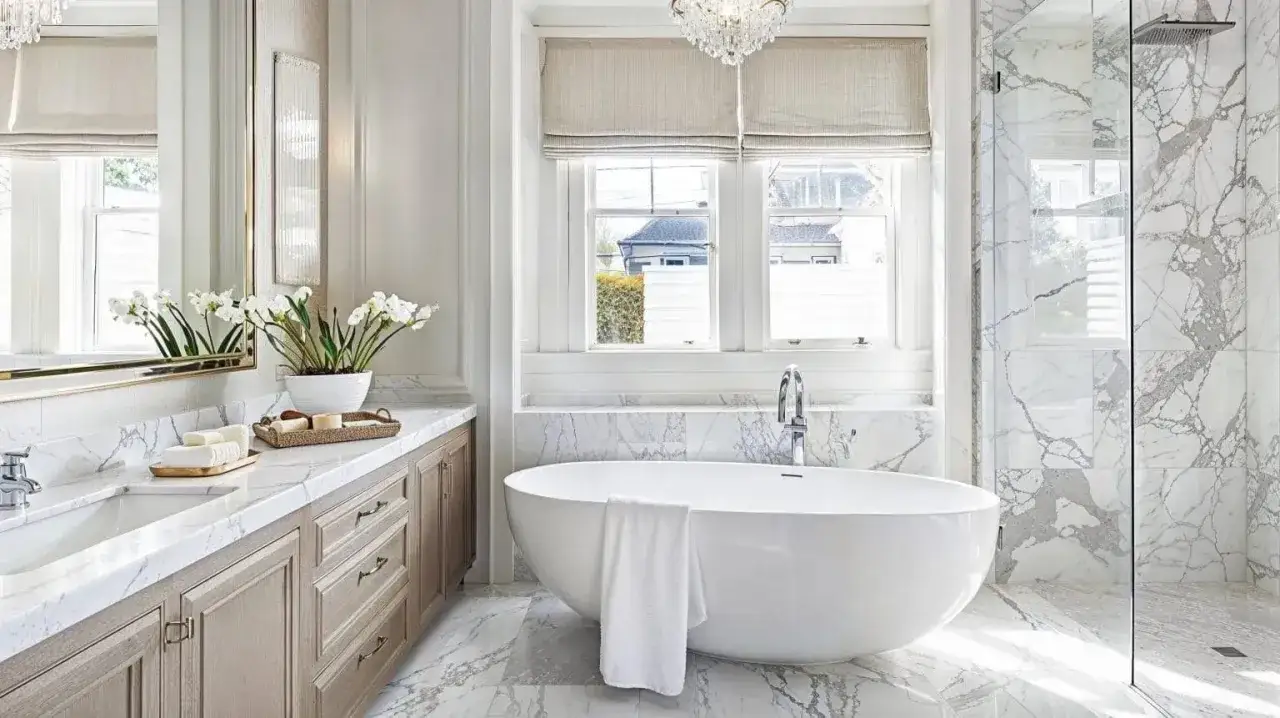
What makes a bathroom tile feel current
The strongest 2026 direction is warmer and less clinical. I’m seeing sand, clay, mushroom, muted green, and soft blue replacing the icy gray palette that got tired so fast. Subway tile is still useful, but it looks more current when it is longer, stacked vertically, slightly glossy, or paired with a dimensional field tile or handmade-look accent. Terrazzo, zellige-inspired surfaces, a handmade glazed look with soft variation, and subtle 3D textures are also doing well because they add depth without making a bathroom feel noisy.
- Long rectangular wall tile keeps the room crisp without feeling busy.
- Dimensional or fluted accents add shadow and movement on one focal wall or niche.
- Soft terrazzo or stone looks give the floor enough visual character to hide daily wear.
The point is not to chase the loudest trend. It is to choose one or two details that make the room feel lived-in and deliberate, then keep the rest of the palette calm. Once you know the look you want, the next decision is the material, because the same finish can behave very differently on a wall, a shower, or a floor.
Which materials make sense on walls, floors, and showers
When I specify tile, I split the room by surface, not by style. A wall can handle more visual freedom; a floor has to survive water, soap, and traffic. That is why the same tile line may work beautifully on a shower wall but feel wrong on the main floor.
| Material | Best use | Why I reach for it | Watch-outs | Typical U.S. material price per sq ft |
|---|---|---|---|---|
| Ceramic | Drier wall areas, tub surrounds, budget renovations | Easy to cut, broad color range, good for crisp wall patterns | Less dense than porcelain, so I usually avoid it for hard-working floors | $0.50-$7 |
| Porcelain | Most floors, showers, and mixed wall-floor designs | Dense, moisture-resistant, and available in stone, terrazzo, and wood looks | Harder to cut and often costs more to install well | $2-$10 |
| Natural stone | Feature walls, premium floors, luxury baths | Rich variation and a quieter, more organic feel | Needs sealing and more maintenance; marble is softer than porcelain | $5-$20, with marble often $10-$20 |
| Glass or mosaic accents | Niches, trim bands, vanity backsplashes, shower detail | Adds sparkle or contrast without taking over the room | Best as an accent, not the main answer for every surface | Varies widely |
For most homeowners, porcelain is the safest balance of looks and performance. Ceramic still makes sense when the budget is tight and the wall surface is doing most of the work. Natural stone can be beautiful, but I only recommend it when the owner is comfortable with sealing, patina, and a little more maintenance. That leads naturally to the part that most affects daily use: how each surface should actually be tiled.
How I would tile each bathroom surface
I get the best results when I think in zones. The shower wall, shower floor, and main floor each ask for something different, even if they all come from the same collection.
Walls that should feel calm, not flat
On walls, I like formats that make the room read taller or wider without shouting. Vertical stacked subway tile, 3x12 or 4x16 rectangles, and large-format slabs all work well here. Gloss or satin finishes can look clean on walls because they bounce light, but I keep the tone controlled so the room does not start feeling sterile.
Shower walls that need to stay easy to clean
Shower walls are where larger tile pays off. Fewer grout joints mean less visual noise and less scrubbing. If the shower is the focal point, I often use a large-format porcelain tile on the field wall and reserve a textured or handmade-look tile for a niche or one feature wall. That gives the room personality without turning the whole enclosure into a pattern exercise.Shower floors that need grip first
For the shower floor, smaller tiles usually behave better because they follow the slope more naturally and give you more grout lines for traction. A 2x2 mosaic, hex mosaic, or small tumbled-look porcelain often beats a giant slab in this zone. The look can still be modern; it just needs to be practical before it is pretty.
Read Also: Porcelain Tile Durability - What Really Makes It Last?
Main floors that need to pass the wet test
On the main bathroom floor, I favor matte or softly textured porcelain. A useful benchmark in ANSI/TCNA guidance is a wet DCOF, or dynamic coefficient of friction, of 0.42 or higher for interior floors intended to be walked on when wet. That said, no tile is truly slip-proof. If you want a polished look, I keep it for walls or for powder rooms that never see much water. Once the surface choices are clear, the pattern and grout details start doing the heavy lifting.
Patterns, grout, and layout details that change the whole room
Small design decisions have an outsized effect in a bathroom because the surfaces are close to the eye. I can make the same tile feel quiet, graphic, or tailored just by changing the layout and grout strategy.
- Stacked bond, where the tile edges line up directly, feels the most contemporary because the joints create a clean grid.
- Vertical stack is useful when ceilings feel low; it pulls the eye upward and makes compact baths feel taller.
- Herringbone, a zigzag layout, adds movement without becoming loud, especially in a narrow shower wall or floor border.
- Checkerboard can feel fresh again when the colors are softened, not high contrast and harsh.
- Rectified tile is machine-cut after firing so the edges are more uniform, which helps when I want tighter joints and a more finished look.
If the room feels too safe, pattern can supply just enough tension. If it already has texture, I keep the layout quieter so the bath does not start competing with itself. Once that balance is right, the remaining question is usually money.
What a realistic tile budget looks like in the U.S.
Most tile projects are less expensive than a full bathroom remodel, but they are rarely just the price of the tile itself. Labor, cuts, leveling, waterproofing, grout, trim, and demolition can change the total fast. I usually separate budget into surface cost and install complexity so there are fewer surprises.
| Project size | Typical U.S. range | What usually drives the total |
|---|---|---|
| Bathroom floor tile installation | About $5-$17 per sq ft for ceramic, up to $19 for porcelain, and up to $24 for premium marble | Tile material, floor prep, and how much cutting is required |
| Small bathroom floor examples | 40 sq ft: $360-$840; 75 sq ft: $680-$1,580; 100 sq ft: $900-$2,100 | Room size and product grade |
| Shower tile installation | About $1,800-$5,000 on average, with materials often $10-$25 per sq ft | Waterproofing, wall height, niches, and tile complexity |
| Material-only tile cost | Roughly $0.50-$20+ per sq ft for many common bathroom options | Ceramic and porcelain stay affordable; marble and specialty looks climb quickly |
The rule I use is simple: if the tile choice makes the install harder, the labor line will grow even when the product itself looks affordable. Large-format tile, thin slabs, heavy stone, and detailed patterns all need more precision. That is why the best-looking quote is not always the best value. The next section is where I try to prevent the most expensive mistakes before they happen.
The mistakes I would avoid before ordering anything
- Choosing glossy floor tile for a wet bathroom because it looks bright in the showroom. Shine is not the same thing as safety.
- Mixing too many finishes in one small bath. When everything is a statement, nothing reads clearly.
- Ignoring substrate flatness, meaning the shape of the base under the tile, before buying large-format tile. Bigger pieces expose every dip and hump.
- Using natural stone without planning for sealing and upkeep. The surface may age beautifully, but only if you accept the maintenance.
- Forgetting to order extra tile. I usually plan for 10% overage for simple layouts and 15% or more for diagonal cuts, patterns, or shower niches.
- Picking the tile before checking the room’s lighting. A matte sand tone can look soft in daylight and flat under a weak vanity fixture.
These are the mistakes that turn an otherwise good bathroom into a frustrating one. If you keep the room’s actual conditions in view, the tile choice becomes easier, not more complicated. From there, I narrow the options by room type, which is the fastest way to land on a design that feels current and still makes sense six years from now.
The tile spec I would start with in different bathrooms
When I want a bathroom to feel modern without looking like it was built around a trend calendar, I start with a simple spec and then adjust one or two details. That approach keeps the room coherent.
- Small guest bath: warm white or sand matte porcelain on the floor, vertically stacked wall tile, and grout close to the tile color.
- Primary bath: large-format porcelain on the shower walls, a textured accent in the niche or behind the vanity, and a small mosaic shower floor for grip.
- Family bath: durable porcelain floor tile with a wet-friendly finish, medium-size wall tile that is easy to clean, and a restrained palette that hides daily wear.
- Design-forward bath: terrazzo-look flooring or a zellige-inspired wall, but only if the rest of the room stays quiet enough to let that detail breathe.
That is usually the difference between a bathroom that feels modern today and one that still feels considered after the novelty has worn off. I keep coming back to the same formula: choose the right material for the surface, keep the palette disciplined, and let texture do more work than pattern.