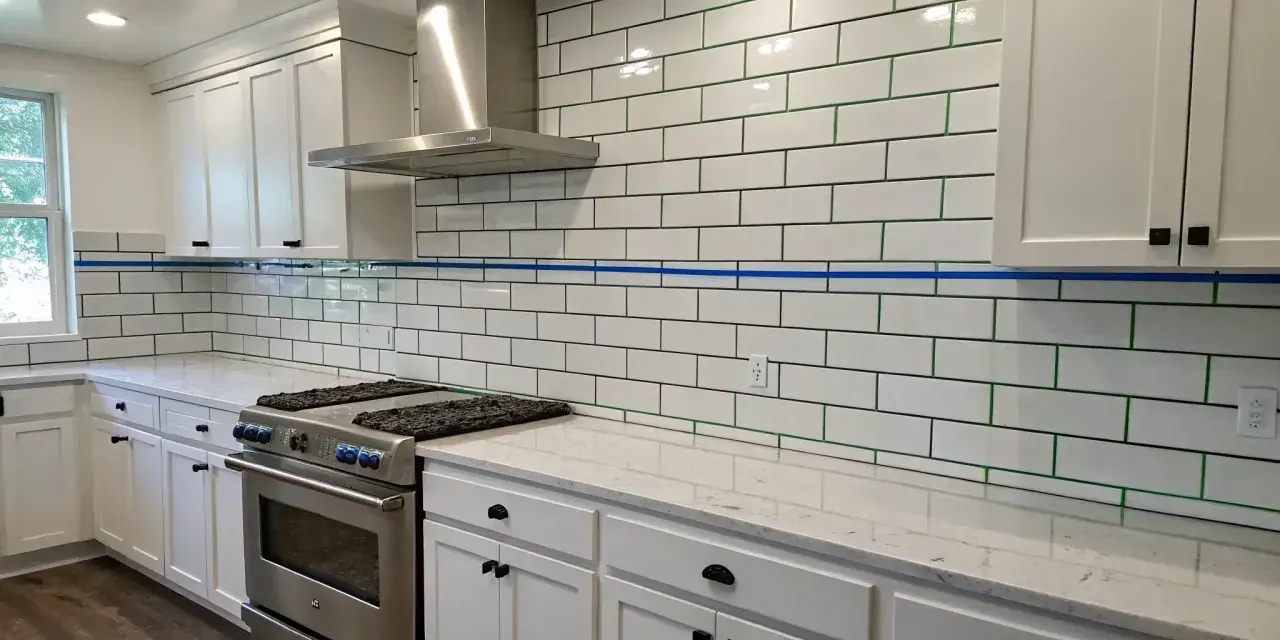
The budget range that matters most before you hire
- Most standard professional backsplash installs in 2026 land around $480 to $1,500, with simpler jobs sitting lower and detailed projects climbing higher.
- A practical planning range is about $15 to $40 per square foot, while fuller mid-range estimates can start closer to $28.31 to $49.78 per square foot depending on conditions.
- Ceramic and porcelain usually stay on the lower end; glass, stone, and marble push labor and waste upward.
- Old tile removal, drywall repair, and outlet work are the most common add-ons.
- A written quote should separate materials, labor, prep, and cleanup so you can compare bids fairly.
What a professional backsplash installation usually costs
If I had to reduce backsplash pricing to one sentence, I would say the quote is mostly a story about square footage plus complexity. A clean 20-square-foot run of ceramic tile can stay in the low hundreds, while a larger pattern-heavy installation can move into the low thousands once labor and prep are fully counted.
| Backsplash size | Typical installed cost | What that usually means |
|---|---|---|
| 15 sq ft | $225 to $600 | Small accent run or compact kitchen section |
| 20 sq ft | $280 to $800 | Lightly detailed job with modest cuts |
| 25 sq ft | $350 to $1,000 | Average-sized splash with a standard layout |
| 30 sq ft | $450 to $1,200 | Medium kitchen wall or longer run behind counters |
| 40 sq ft | $600 to $1,600 | Large wall area or more detailed finish work |
| 50 sq ft | $750 to $2,000 | Fuller kitchen coverage with more labor built in |
What actually pushes the price up or down
I rarely see backsplash pricing driven by one factor alone. The final number usually comes from a mix of material choice, layout difficulty, wall condition, and how much time the installer spends on details the homeowner never notices until the wall is finished.
| Cost driver | Why it matters | Typical effect on the bill |
|---|---|---|
| Tile size and material | Fragile, heavy, or premium tiles take more care and create more waste | Raises labor time and often raises material cost too |
| Layout complexity | Herringbone, diagonal layouts, and mosaics need more planning and precision | Increases labor more than a simple straight run |
| Outlets, corners, and windows | Every cut adds time, and every visible edge has to look clean | Usually pushes the bid upward |
| Wall condition | Uneven drywall, old adhesive, or moisture damage has to be corrected first | Can add prep work before tile even starts |
| Job size and local labor market | Small jobs can trigger minimum charges, and busy markets price higher | Can make two similar projects cost very differently |
A professional install is more than spreading thinset and pressing tile into place. Good crews also measure, protect the work area, secure backer board when needed, cut around electrical boxes, grout, and clean up. That is why a backsplash with a lot of outlets or a tricky edge profile often costs more than a larger but simpler wall. The next step is seeing how the tile itself changes the budget.
How tile choice changes the budget
If I were balancing budget and style, I would start with ceramic or porcelain and move upward only if the visual payoff is worth it. The material you choose affects both the purchase price and the amount of care the installer needs to take during cutting, fitting, and finishing.
| Tile type | Material cost tendency | What it does to the install |
|---|---|---|
| Ceramic or subway tile | About $2 per square foot | Usually the most budget-friendly and easiest to install |
| Porcelain | About $3 to $6 per square foot | Still efficient to install, with strong durability |
| Glass tile | Around $30 per square foot | More careful cuts and handling because chips show quickly |
| Natural stone | About $7 to $45 per square foot | Usually needs more sealing, more time, and more waste planning |
| Marble | About $20 to $130 per square foot | Luxury look, but the most likely to push the total up fast |
In practice, ceramic and porcelain often sit near the lower end of the installed price range, while glass, stone, and marble move the project upward because they are less forgiving. A marble backsplash can turn a tidy renovation into a high-end finish very quickly, and that is before sealing and extra labor are counted. That is why tile selection is not just a design choice; it is a cost decision too.
The extra charges people forget to budget for
The quote that looks cheapest on paper is often the one with the fewest items included. I always tell homeowners to look for the charges that appear only after the old surface comes off or the installer starts working around the room’s real-world details.
| Extra item | Typical add-on | Why it matters |
|---|---|---|
| Old backsplash removal | $3 to $6 per square foot | Demolition often exposes adhesive, drywall, or backer board issues |
| Drywall or backer board repair | Varies by damage | Can become the real cost driver if the wall is not sound |
| Outlet or GFCI changes | About $130 to $300 per outlet | Electrical updates can be required when the layout changes |
| Grout, caulk, sealant, and trim pieces | Usually small individually | These details add up on larger or more decorative jobs |
| Disposal and cleanup | Sometimes bundled, sometimes separate | Important if you are comparing bids line by line |
This is where many homeowners get surprised. A quote can look reasonable until the contractor opens the wall and finds damaged drywall or the need to move electrical hardware. When the backsplash is part of a larger kitchen remodel, some of those setup costs may be easier to absorb, but on a stand-alone job I would budget a cushion. The next section shows how I would do that without overthinking it.
How I would estimate a backsplash budget before calling contractors
I use a simple method because it keeps the estimate grounded. The point is not to predict the exact invoice down to the dollar. The point is to know whether a bid is in the right neighborhood before you spend time comparing three or four contractors.
- Measure the finished backsplash area in square feet.
- Choose a planning rate based on tile complexity and wall condition.
- Add removal or repair costs if the old backsplash has to come off.
- Add a 10% to 15% cushion for waste, small surprises, and extra trim or sealant.
Here is the kind of estimate I would make in my head. A 20-square-foot ceramic backsplash with a fairly clean wall might sit around $280 to $800 before extras. If old tile removal adds $3 to $6 per square foot, that same project can gain another $60 to $120 before the new tile even goes up. A 35-square-foot splash with more outlets, a tougher pattern, or a premium tile can land much higher, and that is normal rather than alarming.
The biggest mistake I see is treating the lowest per-square-foot number as the final cost. It is only useful if the quote clearly includes prep, tile setting, grout, cleanup, and any electrical or repair work. If it does not, the total will drift upward later. That is the point where the DIY-versus-pro decision starts to matter.
When hiring a pro is worth the money
Not every backsplash needs a specialist-level crew, but some absolutely do. I would not pay a premium installer just to set plain subway tile on a dead-flat wall with a few easy cuts. I would pay one quickly for anything involving glass, marble, herringbone patterns, awkward corners, or a wall that needs prep before tile can even begin.
| Situation | Best move | Why |
|---|---|---|
| Straight-run ceramic on a smooth wall | DIY or a simple pro bid | Lower risk and fewer complicated cuts |
| Glass, marble, or natural stone | Hire a pro | Precision matters and mistakes are expensive |
| Mosaic or herringbone layout | Hire a pro | The layout is much easier to get wrong than it looks |
| Old tile removal or drywall damage | Hire a pro | Hidden repair work can change the scope quickly |
| Many outlets or unusual edges | Hire a pro | Clean cutouts and alignment are hard to fake |
In my view, the real value of a pro is consistency: straight lines, even grout joints, clean outlet cutouts, and a finish that does not pull attention for the wrong reasons. If the backsplash is a visible focal point in the kitchen or bath, that consistency is often worth more than the labor savings. Once you decide to hire, the last thing to check is whether the quote is written in a way that protects you.
The quote details I would never skip
A good backsplash quote should make it obvious what you are paying for. If it does not, I would ask for a revised version before signing anything.
- Exact square footage and tile type
- Whether labor, materials, grout, caulk, and sealant are included
- Whether wall prep, patching, or backer board is part of the price
- Who handles old backsplash removal and disposal
- How many outlet or appliance cutouts are covered
- Timeline, cleanup, and any warranty or touch-up policy
The best quote is not the lowest number on paper; it is the one that tells you what is included before the wall is opened. If you compare bids line by line and budget a cushion for demolition or outlet work, you will avoid the most common surprises and end up with a backsplash that looks intentional instead of expensive by accident.