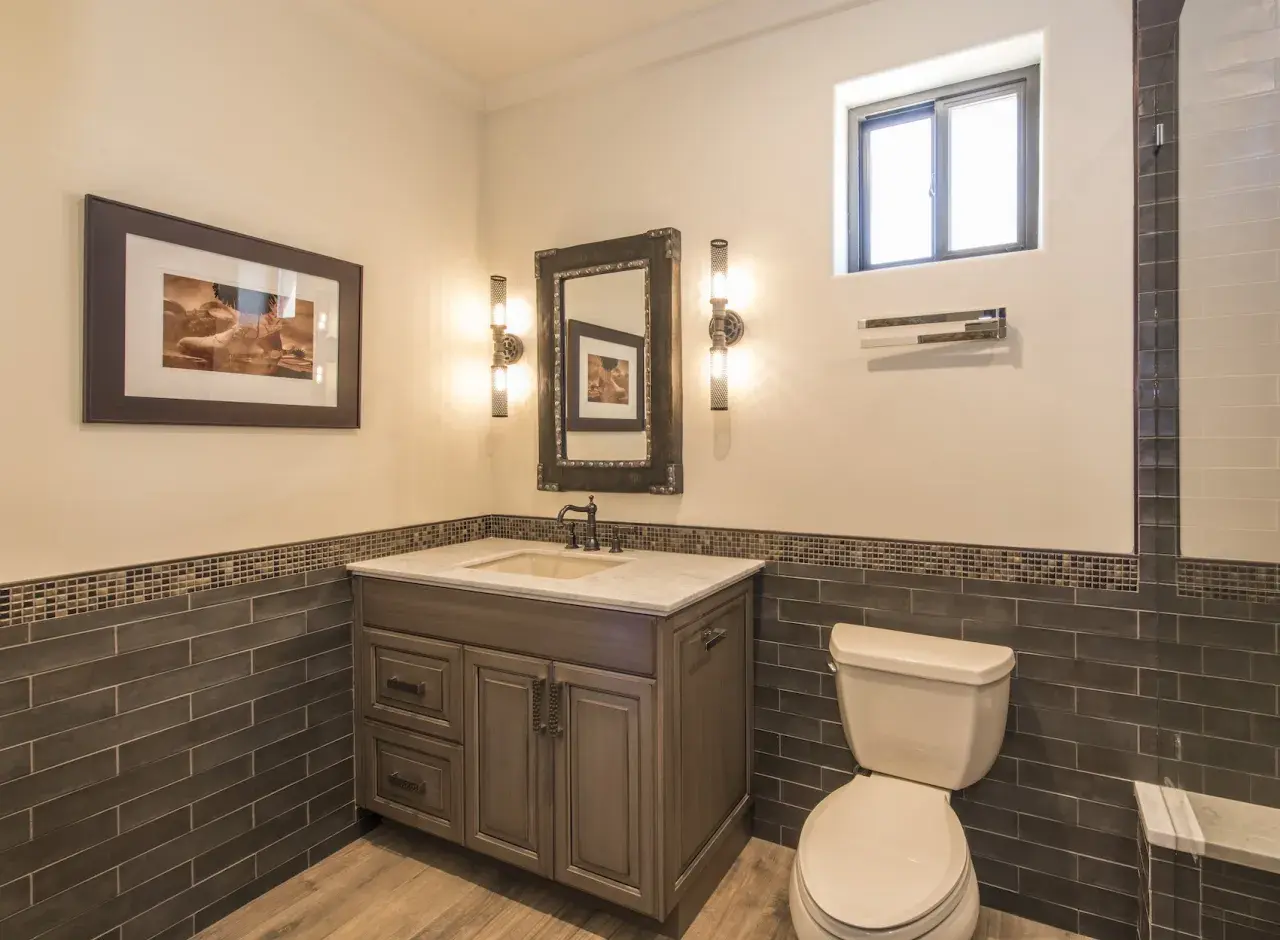
Bathroom wall lights only feel simple until you have to place them on an actual wall. There is no single sconce height from floor that works in every bathroom, because mirror height, ceiling height, and the shape of the fixture all change the result. I focus on one goal: keep the light at eye level, reduce facial shadows, and make the vanity look intentional instead of improvised.
The quickest rule for bathroom sconce placement
- Start with 65 to 70 inches from the finished floor for side-mounted vanity sconces.
- Use about 75 to 80 inches from the floor for an above-mirror fixture.
- Measure to the center of the light source or mounting point, not just the top of the backplate.
- Keep the light near eye level so the face is evenly lit and glare stays down.
- Adjust for mirror height, fixture shape, and the people who use the bathroom most.
The height rule that works in most bathrooms
For most US bathrooms, I start with 65 to 70 inches from the finished floor when I am placing a pair of sconces beside a vanity mirror. Houzz quotes the American Lighting Association’s general rule in that same range, and it is a solid starting point because it lands the light close to eye level. That is where a bathroom sconce does its best work: flattering the face without shining directly into it.If the room is compact, the users are shorter on average, or the fixture has a low visual profile, I may slide closer to 60 to 66 inches. I prefer to think of that as the usable window rather than a rigid rule. Too high and you get a hard shadow under the eyes and nose; too low and the fixture starts competing with the mirror. Once the height is in the right zone, the room usually begins to feel more balanced immediately.
| Placement | Starting height from finished floor | Best for | Main watch-out |
|---|---|---|---|
| Side-mounted pair beside the mirror | 65 to 70 in | Most flattering grooming light | Keep the bulb or shade near eye level |
| Single fixture above the mirror | 75 to 80 in | Tight walls and larger mirrors | Can feel more top-down if the fixture is too small |
| Side-wall sconce in a narrow bath | 65 to 70 in | Preserves mirror width | Watch mirror edges and door swing |
| Decorative accent sconce | 60 to 72 in | Atmosphere more than task lighting | Usually needs a second light source at the vanity |
Those are starting points, not rules carved into tile. The next step is making sure the measurement means the same thing on paper and on the wall.
How I measure the height so the number makes sense on the wall
I measure from the finished floor, not the subfloor, because bathroom flooring changes can shift the final height more than people expect. I also measure to the center of the light source or the center of the backplate, depending on how the fixture is built. Lumens uses eye level as a rough target for wall lights, typically 60 to 66 inches to the center of the fixture, which matches the logic I use here.
- Mark the finished-floor line first.
- Find the centerline of the sink and mirror.
- Measure to the center of the fixture, not just the top of the plate.
- Check whether the shade, glass, or exposed bulb lands in or near the sightline.
- Confirm that the fixture clears the mirror frame, medicine cabinet, and any trim.
The key detail is that not every sconce presents the bulb the same way. A long-arm fixture, a globe, and a shaded sconce all read differently at the same mounting point, so I always check the actual visible light, not just the plate.
Once that is clear, mirror height and vanity layout start doing more of the work than the fixture itself.

How mirror height and vanity layout change the answer
A tall mirror, a short mirror, and a medicine cabinet all push the sconces into different visual relationships. That is why I do not pick height in isolation. I pick it after I know where the mirror starts, how much wall is available at the sides, and whether the vanity is single-sink or double-sink.
On a single vanity, I usually want the sconces to frame the mirror rather than hover far outside it. In smaller layouts, that often means keeping the pair around 28 to 30 inches apart, then adjusting so the fixtures feel tied to the mirror edges. On a double vanity, I generally prefer separate lighting zones for each sink instead of one oversized fixture trying to cover everything at once.Mirror height matters just as much. If the mirror sits low, a standard wall-light height may feel crowded; if the mirror sits high, the same number can look too low and awkward. In practice, I ask one question first: do I want the sconce to disappear into the composition, or do I want it to read as a deliberate design element? That answer often changes the final mounting line more than the fixture style does.
In a narrow bath, side walls can save the mirror from feeling boxed in. That keeps the room functional without sacrificing visual breathing room, and it leads directly to the next choice: side sconces, an overhead fixture, or both.
Side sconces, an overhead fixture, or both
For face lighting, side-mounted sconces still outperform most overhead-only solutions. They reduce shadows by bringing light in from both sides of the mirror, which is exactly what you want for shaving, skincare, and makeup. An overhead fixture can work well, but it has to fight gravity; it tends to throw light downward rather than across the face.
| Option | Best when | Strength | Limitation |
|---|---|---|---|
| Side sconces | You have enough wall width beside the mirror | Most even and flattering for grooming | Needs careful spacing and clear mirror edges |
| Above-mirror fixture | The wall is too tight for side placement | Clean, simple, and easy to center | More top-down shadow if the fixture is undersized |
| Both | The bathroom is large enough for layered light | Strong task light plus better ambient coverage | Needs dimming or the room can feel harsh |
My default is simple: if the wall can support side placement without crowding the mirror, I use side sconces. If the wall is tight or the mirror is already large, I switch to an above-mirror fixture. When the bathroom is generous enough for both, I use both only if one layer can be dimmed so the room does not feel harsh.
Most of the bad results I see come from ignoring the tradeoffs in that choice, which is why the common mistakes matter so much.
The mistakes that make a good fixture feel wrong
The wrong height is often the result of several small misses, not one dramatic error.
- Measuring before the finished floor is installed.
- Placing the fixture so high that the bulb sits in the user’s direct sightline.
- Choosing a mirror or medicine cabinet first and leaving no usable side wall for the lights.
- Spacing side sconces so far from the mirror that they look detached.
- Relying on one vanity light to do the work of the whole bathroom.
- Ignoring the fixture’s shape, which can move the real light source well above or below the mounting plate.
If you avoid those mistakes, the installation starts to feel much more precise. The remaining decisions are about making the light pleasant to live with day after day.
The final checks I would make before drilling the wall
Height alone does not finish the job. I still check color temperature, dimming, and the fixture rating before I call a vanity wall light truly ready. For most bathrooms, 2700K to 3000K LEDs feel flattering without going yellow, and a dimmer makes the same sconces useful at 6 a.m. and again late at night. Lumens also points designers toward roughly 1,600 lumens of total vanity output, which is a useful reminder that even a perfectly placed light can still feel weak if the room is underlit.I also match the fixture to the room’s conditions. Near steam, I want a damp-rated fixture, meaning one built for humid spaces even if it is not exposed to direct spray; in a highly polished bathroom, I avoid anything so busy that it competes with the mirror and faucet; and if I am working with multiple users, I favor a height that lands in the middle of the range rather than chasing one person’s eye level at the expense of everyone else’s. When I am unsure, I mock up the height with painter’s tape, stand at the vanity, and look at it in the mirror before I commit to drilling holes. That quick test usually tells me more than a dozen measurements do.
