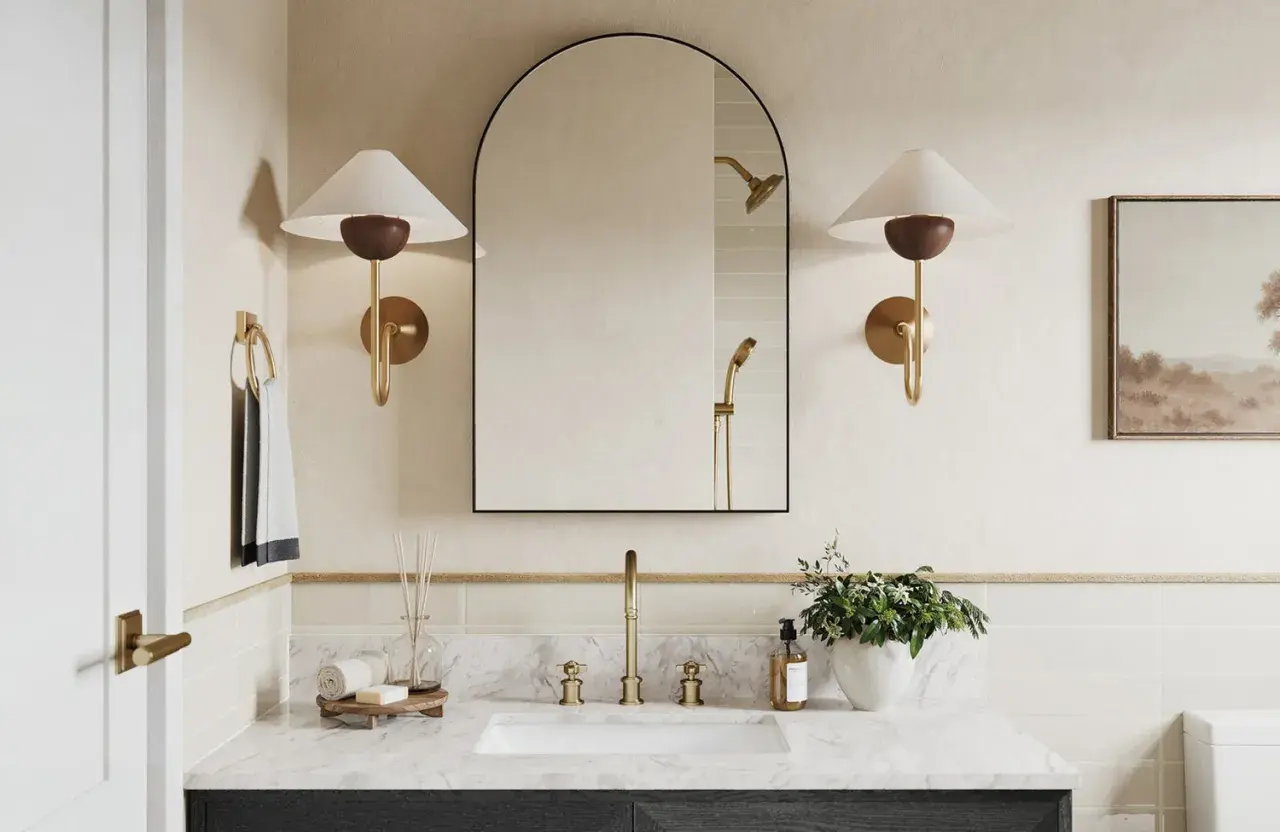
The mirror should usually be a little narrower than the vanity
- Best width: 28 to 32 inches for a rectangular mirror over a 36-inch vanity.
- Best default: 30 inches wide is the safest all-around choice.
- Best height: 30 to 36 inches tall, depending on the ceiling, faucet, and light fixtures.
- Best bottom gap: leave about 5 to 10 inches above the vanity top or the highest faucet point.
- With sconces: keep extra room on the sides, or use a narrower mirror.
- Main rule: don’t let the mirror feel wider than the vanity unless the design is very deliberate.
The safest answer for a 36-inch vanity
If I had to give one practical answer, I would choose a 28- to 32-inch-wide mirror for a 36-inch vanity, with 30 inches wide as the most reliable default. That range gives the mirror enough presence to anchor the sink without swallowing the cabinet. For height, I usually work in the 30- to 36-inch-tall range, because it gives enough vertical coverage for daily use without crowding the wall or the lighting.
A full 36-inch-wide mirror can work in a very minimal room, but it is harder to balance and it leaves almost no visual breathing room. For most bathrooms, a slightly narrower mirror looks more finished, and it is easier to pair with lighting and backsplash details. That width decision sets the tone, but the next step is translating the vanity into a real mirror dimension that fits the wall.
How I translate vanity width into mirror width
The simplest sizing rule is to keep the mirror slightly narrower than the vanity, usually by a few inches on each side. On a 36-inch vanity, that lands you in the 28- to 32-inch range, which is why so many bathroom designers keep returning to it. I also like to think in percentages: a mirror that reads at roughly 80 to 90 percent of the vanity width usually feels balanced, as long as the frame is not too heavy.
| Mirror size style | Practical size for a 36-inch vanity | Why it works |
|---|---|---|
| Rectangular mirror | 28 to 32 inches wide, 30 to 36 inches tall | Most balanced and easiest to align with faucets, tile, and sconces |
| Frameless rectangle | 30 to 36 inches wide, 30 to 36 inches tall | Reads lighter visually, so it can handle a slightly larger footprint |
| Round mirror | 24 to 30 inches in diameter | Softens the vanity and works well in smaller or more modern bathrooms |
| Oval or arched mirror | 24 to 30 inches wide, 30 to 40 inches tall | Adds height and style without making the wall feel blocky |
| Medicine cabinet mirror | 24 to 30 inches wide, depending on storage needs | Best when hidden storage matters more than decorative scale |
One detail I never ignore is the outer dimension. A framed mirror measures larger than the glass inside it, and that frame can be the difference between a mirror that feels clean and one that feels too large. Once you know the width, the shape becomes the next design decision, because shape changes how big that width actually feels on the wall.
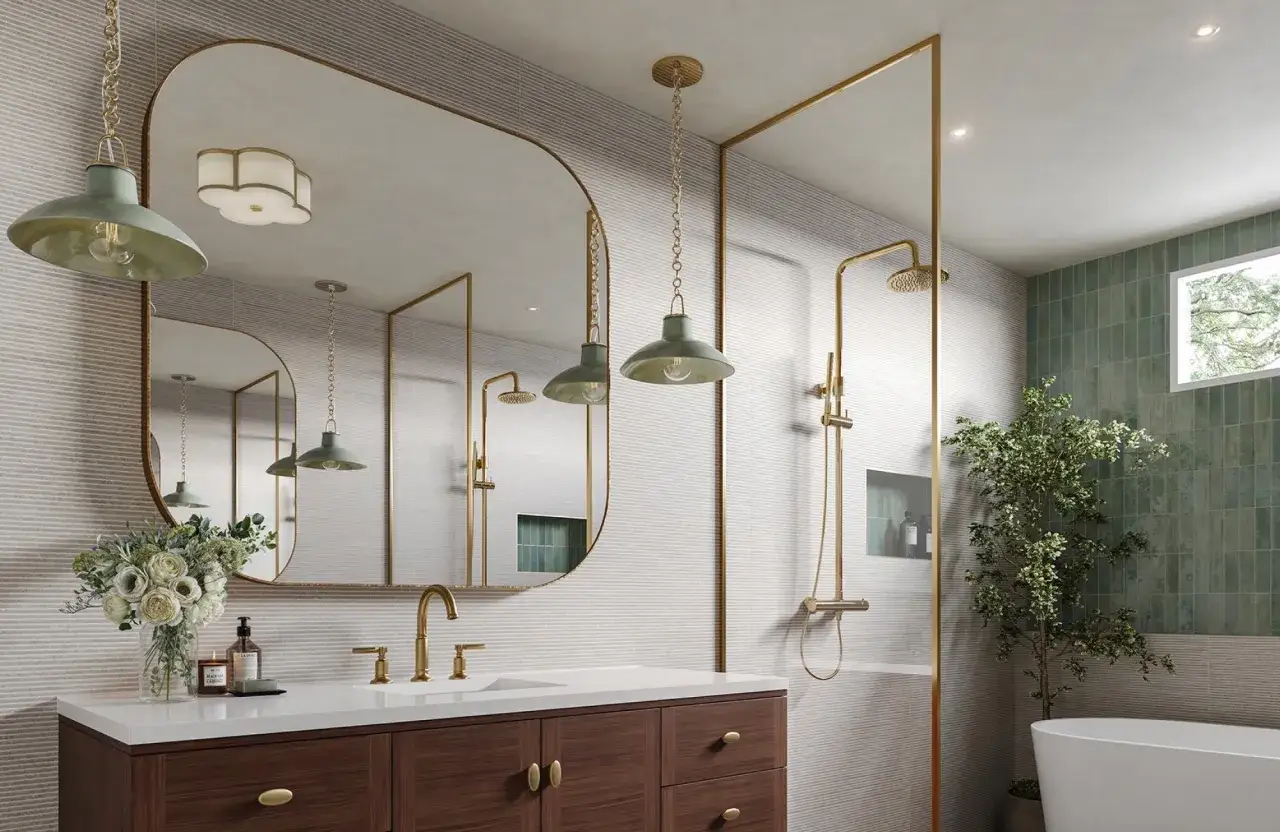
Which shape works best for the space
For a 36-inch vanity, rectangular mirrors are the safest choice. They echo the vanity’s geometry, they are easy to center, and they work especially well when the room already has strong lines in the tile or cabinetry. If the bathroom feels rigid or boxy, though, I often soften it with a round, oval, or arched mirror.
- Rectangular: best for a clean, classic look and the easiest fit over a single sink.
- Round: a good choice when you want the wall to feel lighter; I usually keep it in the 24- to 30-inch range.
- Oval: a little more elegant than round, with enough height to feel useful without taking over the wall.
- Arched: strong if you want a more current, architectural look; it works best when the mirror is tall enough to justify the curve.
My rule is simple: if the vanity and the bathroom are already busy, use a straightforward rectangle. If the room needs softness or a bit of personality, move to a round or arched shape, but keep the scale controlled. Shape alone does not solve sizing, because lighting and placement can push the mirror size up or down more than people expect.
Placement and lighting can change the size you should buy
Mirror size is never just about the cabinet. The faucet, backsplash, light fixture, and even the height of the people using the room all affect what feels right. I usually leave 5 to 10 inches between the top of the vanity and the bottom of the mirror, measured from the highest point of the faucet if the spout rises high. That spacing keeps the mirror from feeling jammed onto the countertop and helps prevent splashes.
Lighting changes the equation again. If you are using a single bar light above the mirror, you can usually get away with a slightly taller mirror. If you are using side sconces, I prefer to shrink the mirror a bit so the fixtures have room to breathe. That usually means a mirror closer to 28 to 30 inches wide instead of trying to fill every inch of the vanity.
- Overhead light only: you can usually choose a taller mirror, as long as it still clears the faucet.
- Side sconces: keep the mirror narrower so the lights do not feel crowded.
- Tall faucet or wall-mounted spout: raise the mirror’s bottom edge to avoid collisions and splashing.
- Small bathroom: a larger mirror can help the room feel open, but only if it stays visually balanced.
When the mirror and lighting are planned together, the bathroom feels calmer and more useful. That is also where most sizing mistakes show up, so it helps to know the ones I see most often before you buy.
The mistakes that make a 36-inch vanity look off
The biggest mistake is choosing a mirror that matches the vanity width exactly without thinking about the frame, lights, or wall trim. A 36-inch mirror over a 36-inch vanity can work in a highly minimal design, but in many bathrooms it looks heavy and leaves no space for the rest of the wall composition. I also see people choose a mirror based on the glass size alone, then discover the framed version they bought is much larger in practice.
- Ignoring the frame: the listed size may be the glass, not the finished mirror.
- Hanging it too high: a mirror that floats too far above the sink feels disconnected.
- Hanging it too low: it can crowd the faucet and make cleaning harder.
- Forgetting the lights: sconces need side clearance, and that changes the ideal width.
- Choosing by style first: a beautiful mirror still looks wrong if the scale is off.
If the room needs storage, a recessed medicine cabinet can be the smarter choice, especially in a compact bathroom. It solves the mirror problem and the storage problem at the same time, but only if the wall depth and plumbing layout allow it. With those tradeoffs in mind, I would use one final rule to make the purchase decision easier.
The buying rule I would use if this were my bathroom
If the wall is ordinary and you want the safest, most balanced option, I would buy a 30-inch-wide rectangular mirror for a 36-inch vanity. If you prefer a softer look, a 24- to 30-inch round mirror is the next best move. If the bathroom has sconces or a busy backsplash, I would lean narrower rather than wider, because the extra breathing room usually improves the whole composition.
My practical finish line is simple: choose a mirror that feels like it belongs to the vanity, not one that competes with it. When the width, height, and lighting all agree, the bathroom looks more expensive, more intentional, and easier to use every day.