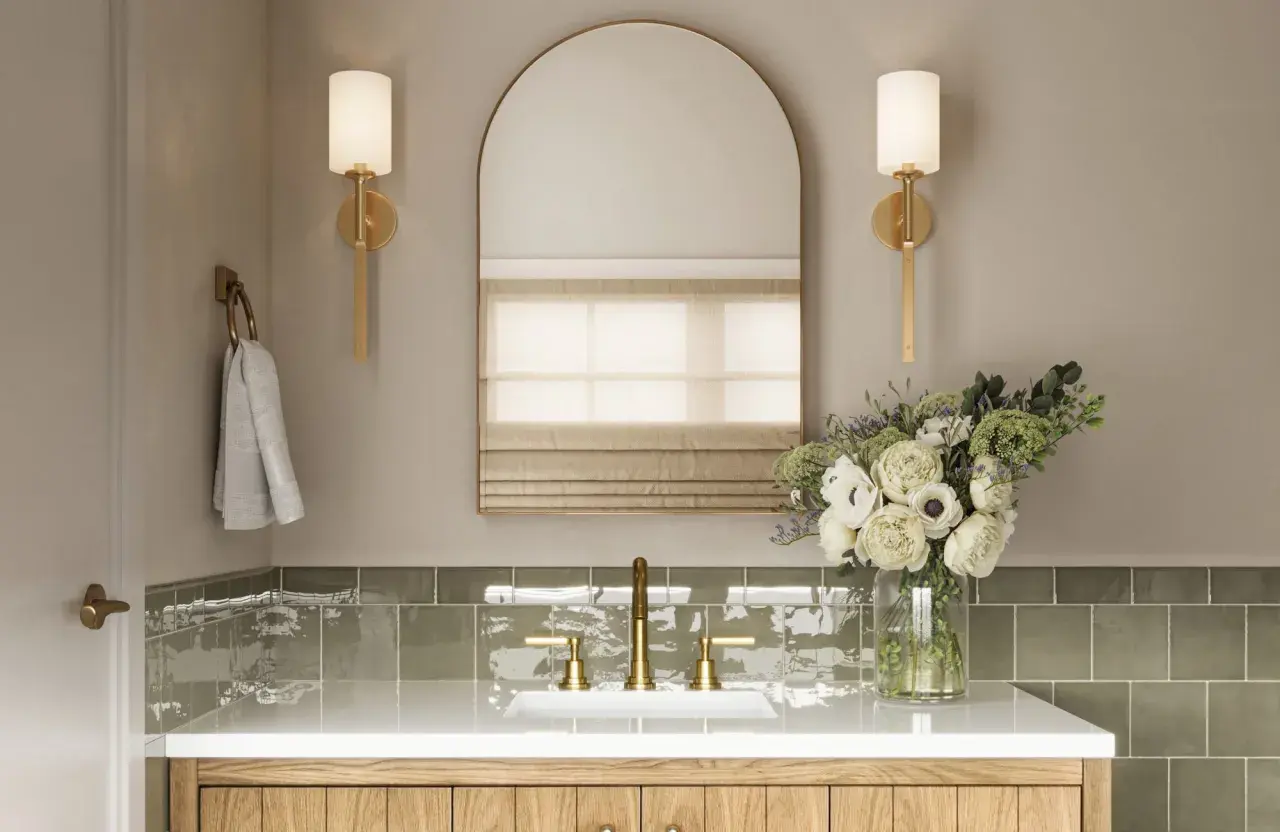
Bathroom vanity lighting is one of those details that looks simple until you start living with it every morning. The up-or-down choice changes how much light lands on your face, how much bounces off the ceiling, and whether the mirror area feels crisp or soft. I’m focusing here on the practical side: when each direction works, how it affects grooming, and what placement rules matter more than style alone.
The shortest answer is that task light belongs at face level, while upward light is best as soft fill
- Down-facing light usually works better for shaving, makeup, and any task that needs clear facial detail.
- Up-facing light creates a softer, more ambient look, but it is usually weaker as the only source at the vanity.
- Side sconces at eye level are often the most flattering and functional option when wall space allows it.
- For above-mirror fixtures, a common placement range is 72 to 80 inches from the floor; side sconces often work best around 60 to 70 inches.
- 2700K to 3000K color temperature and a 90+ CRI usually give the most natural-looking skin tones.
- Dimmers and frosted or opal shades can make either direction feel more polished and less glaring.
What the direction actually changes
The same vanity fixture can feel like a completely different product depending on whether the shades open upward or downward. Up-facing light bounces off the ceiling and spreads a softer wash through the room, while down-facing light sends more output straight to the mirror and countertop. If the vanity is mainly a grooming station, I usually want the second result; if it is mostly about atmosphere, the first can make sense.
| Direction | What it gives you | Works best when | Main tradeoff |
|---|---|---|---|
| Up-facing | Soft ambient light, more ceiling bounce, a gentler overall mood | The bathroom already has task lighting, or the vanity is meant to feel decorative | Less direct light on the face, so grooming can feel underlit |
| Down-facing | Stronger task light, clearer facial definition, better countertop coverage | The mirror is used for daily routines and you want sharper visibility | Can feel harsh if the bulb is exposed or the fixture is too bright |
| Convertible or mixed | Some ambient glow plus some task light | You want one fixture to do more than one job | Performance depends heavily on shade shape, height, and bulb choice |
I rarely think of this as a style-only decision. The direction changes how the bathroom behaves, and that is what matters once the room is in use.
When I would choose down-facing light
This is my default for most everyday bathrooms. If the mirror is used for shaving, makeup, tweezing, skincare, or contact lenses, I want light that lands on the face instead of drifting into the ceiling. Down-facing fixtures are also helpful in darker bathrooms, because they keep more of the output where the work happens.
- The vanity is the main grooming station in the room.
- The bathroom has limited daylight or feels dim in the morning.
- You want clearer detail across the face and countertop.
- The room needs functional light more than decorative glow.
The catch is glare. A down-facing fixture with clear glass and a very bright LED can look stark fast, especially in a small bath with hard surfaces. That is why I usually prefer frosted or opal shades when the light points down. They keep the task light, but they take the edge off it.
When up-facing light earns its place
Up-facing vanity light is the better move when I want the bathroom to feel calmer, taller, and less clinical. It works especially well in powder rooms, guest baths, or spaces where the vanity is not the only light source. The ceiling bounce can soften the room in a way that feels very residential, especially with warm finishes and a mirror that already has strong visual presence.
- The bathroom is used more for guests than for detailed grooming.
- There is already strong ambient or natural light in the room.
- You want a softer, more decorative look.
- The ceiling surface is smooth enough that reflected light will look even rather than patchy.
I would not rely on up-facing light alone for a primary vanity. It can be beautiful, but it is usually not the most efficient way to light a face. In other words, it is better as atmosphere than as the whole answer.
Why side sconces often beat a single bar light
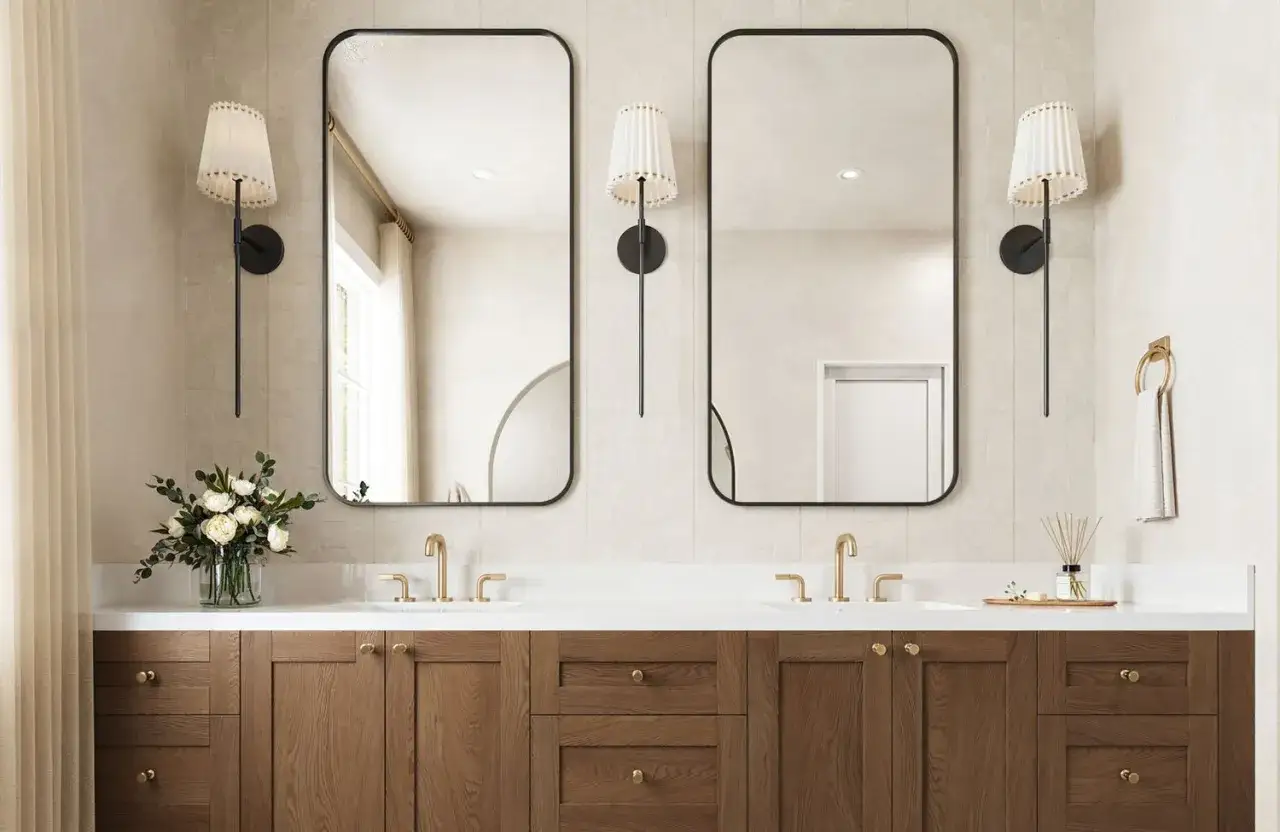
If wall space allows it, side sconces are often the best all-around solution. They place light at face level from both sides, which reduces the shadows under the eyes, nose, and chin that overhead fixtures tend to create. That is why a lot of designers still favor side lighting even when a top bar could technically fit.
| Layout | Why it works | Watch-outs |
|---|---|---|
| Side sconces | Most flattering for faces, very even task light, great for daily grooming | Needs wall space, and medicine cabinets can get in the way |
| Above-mirror bar facing down | Simple retrofit, compact, good when side walls are tight | Can still throw mild shadows if mounted too high |
| Above-mirror bar facing up | Soft and decorative, easy to keep visually light | Usually not enough by itself for detailed grooming |
For side sconces, I usually aim for a mounting height around eye level, roughly 60 to 70 inches from the floor, and I try to keep the fixtures balanced around the mirror. A common spacing range is about 28 to 30 inches apart for a small or medium mirror, but the final number should follow the mirror width and the room’s proportions. If the mirror is wide, the sconces need to move outward with it; if the wall is tight, a well-placed top fixture may be the cleaner compromise.
Placement rules that do more than the up-or-down choice
The direction matters, but placement matters just as much. I like to decide the mirror and the light together, because changing one after the fact often creates awkward proportions or clearance problems. A good vanity layout should look deliberate from across the room and still work up close at the sink.
- For above-mirror fixtures, keep the centerline around 72 to 80 inches from the floor.
- Do not make the fixture wider than the mirror or vanity cabinet; a common rule is to keep it around one-third the mirror width.
- Center the fixture on the sink or plumbing when the layout is fixed, so the whole vanity feels balanced.
- Leave clearance for cabinet doors and mirror edges, especially with medicine cabinets or tall wall mirrors.
- Avoid placing any fixture where it competes with a towel bar, window trim, or a tall faucet; those collisions make the room feel cramped fast.
If I’m working on a remodel, I want these numbers resolved before the drywall is closed. That is the stage where a simple placement decision can save a lot of frustration later.
Bulbs and finishes that make the direction look better
This is where many bathrooms miss the mark. The same fixture can look excellent or awkward depending on the bulb, diffuser, and finish. I usually treat the shade orientation as only part of the equation and then tune the rest so the light feels intentional.
- Color temperature: I usually stay around 2700K to 3000K for a softer residential look, and I move a little cooler only when the room needs more visual sharpness.
- CRI: A 90+ CRI is the safer choice for vanity lighting because skin tones, makeup, and finishes read more naturally.
- Lumens: As a practical planning range, I like about 1,600 lumens for a single vanity and more like 2,500 to 3,000 lumens for larger or darker setups.
- Dimmers: These matter more than people think, because a bathroom needs to feel useful at 6 a.m. and calmer at night.
- Shades and diffusers: Frosted or opal glass softens glare; clear glass gives more sparkle but exposes the bulb, which can look busy in a small room.
- Finish: Chrome and polished nickel reflect more light, matte black reads more graphic, and brass warms the room visually.
If a fixture points up, I care even more about diffusion because the room is being lit indirectly. If it points down, I care more about bulb quality because the light is more direct and more visible.
The setup I would choose for the most common U.S. bathroom layouts
For a small powder room, I would usually choose the prettiest compact fixture that does not fight the mirror, and I am comfortable with up-facing light if the room is more about atmosphere than grooming. For a standard family bathroom with one mirror, I lean toward side sconces when the walls allow it, because they are the most reliable for everyday use. For a double vanity, I prefer symmetry: either a pair of fixtures per sink or a long, well-sized layout that keeps the light centered on each user.
If I had to reduce the whole decision to one sentence, I would say this: choose down-facing or side lighting for real grooming, choose up-facing when you want softer ambient character, and use mirror size, ceiling height, and fixture spacing to decide the final layout. That gives you a bathroom that looks finished in daylight and still works when you are half awake at 6 a.m.