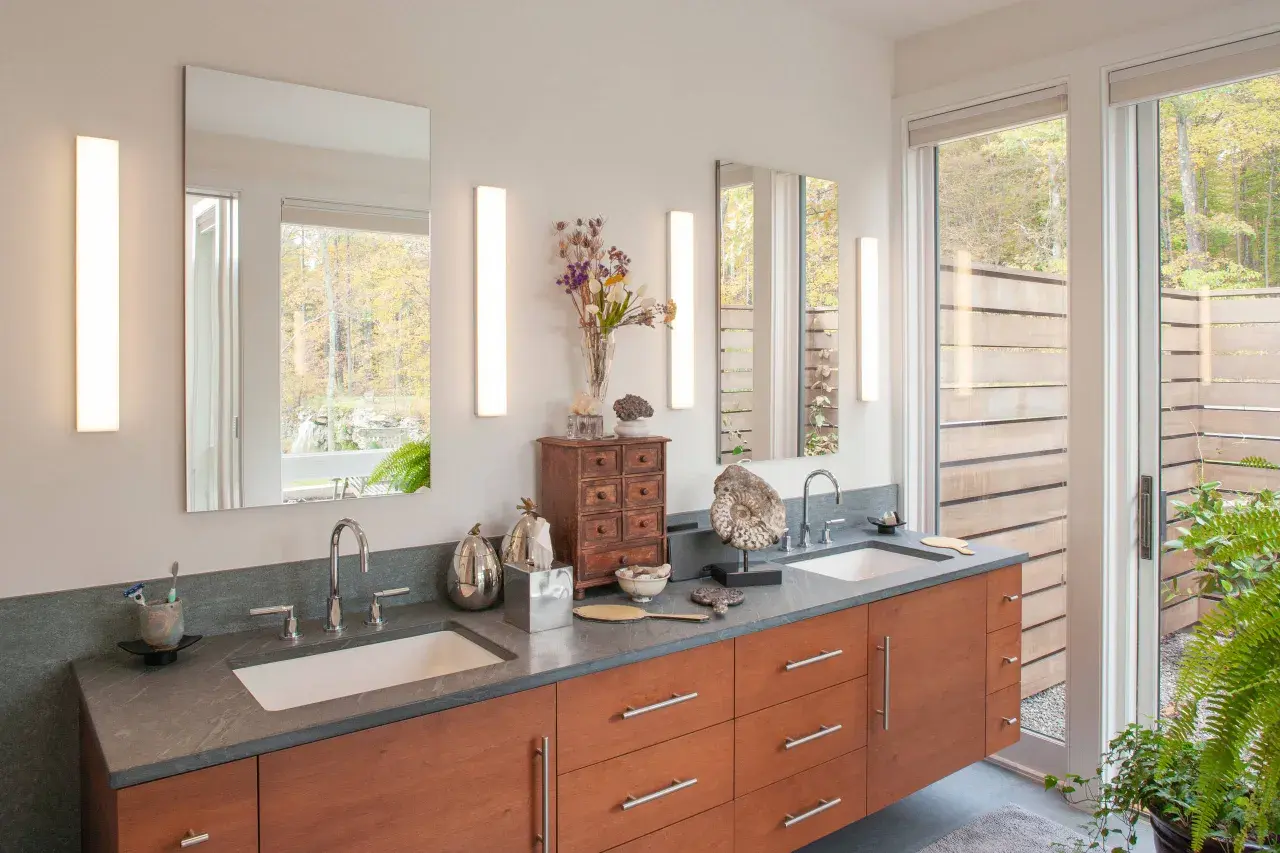
Choosing between a two-light and a three-light vanity fixture is mostly a question of proportion and task lighting. The right setup should brighten the face evenly, sit comfortably with the mirror, and leave the room looking balanced instead of busy. I usually start with the vanity width, the mirror shape, and how much of the bathroom depends on that one fixture for daily use.
The fastest way to choose the right vanity light count
- Two lights usually work best for smaller vanities, narrow mirrors, and bathrooms that already have good ambient light.
- Three lights usually feel more complete over wider mirrors because they spread light more evenly across the face and countertop.
- As a starting point, I like a fixture that lands at about 70% to 80% of the vanity or mirror width.
- For most baths, 2700K to 3000K bulbs and a dimmer give the most usable result.
- If the room is humid or close to a shower, choose a fixture rated for bathroom conditions rather than focusing only on style.
Why the number of lights matters more at the vanity than anywhere else
Vanity lighting is not just decorative. It is task lighting, which means it has to work at face level, not just glow in the room. That is why the number of bulbs matters so much here: a narrow light can leave the outer edges of the face dim, while a wider one can distribute light more evenly across the mirror and sink area. If the fixture is too high, too short, or too centered on the wall instead of the sink, the result is usually more shadow than brightness.| Situation | Two lights | Three lights |
|---|---|---|
| Small vanity | Usually enough and visually cleaner | Can feel crowded |
| Standard single vanity | Works if the mirror is narrow and the room has other light | Often gives better coverage |
| Wide mirror or primary bath | May leave the ends underlit | Usually feels more balanced |
| Double vanity | Usually too limited for shared use | Better, but separate lighting zones can still be smarter |
I think of the count as a way to manage coverage, not as the final answer by itself. The room size, the mirror width, and the amount of natural light all push the decision in one direction or the other, which is why I compare the room before I compare the fixture.
When two lights are the better fit
Two lights make sense when the vanity is compact or when you want the wall to feel calmer. In a powder room, a guest bath, or a narrow single-sink setup, a two-light bar often gives enough light without crowding the mirror. I also lean toward two lights when there is already a ceiling fixture or strong daylight helping the room, because the vanity light does not need to carry the whole load.
- Small vanity widths, especially in the 24- to 30-inch range.
- Narrow mirrors that would look overbuilt with a longer fixture.
- Bathrooms where wall space is tight because of a medicine cabinet, sconces, or trim.
- Minimalist spaces that benefit from fewer visual interruptions.
- Rooms with plenty of ambient light already working in your favor.
The tradeoff is simple: two lights look cleaner, but they can run out of reach on a wider mirror. Once the vanity grows broader or the mirror becomes the main light source, three lights start to make more sense.
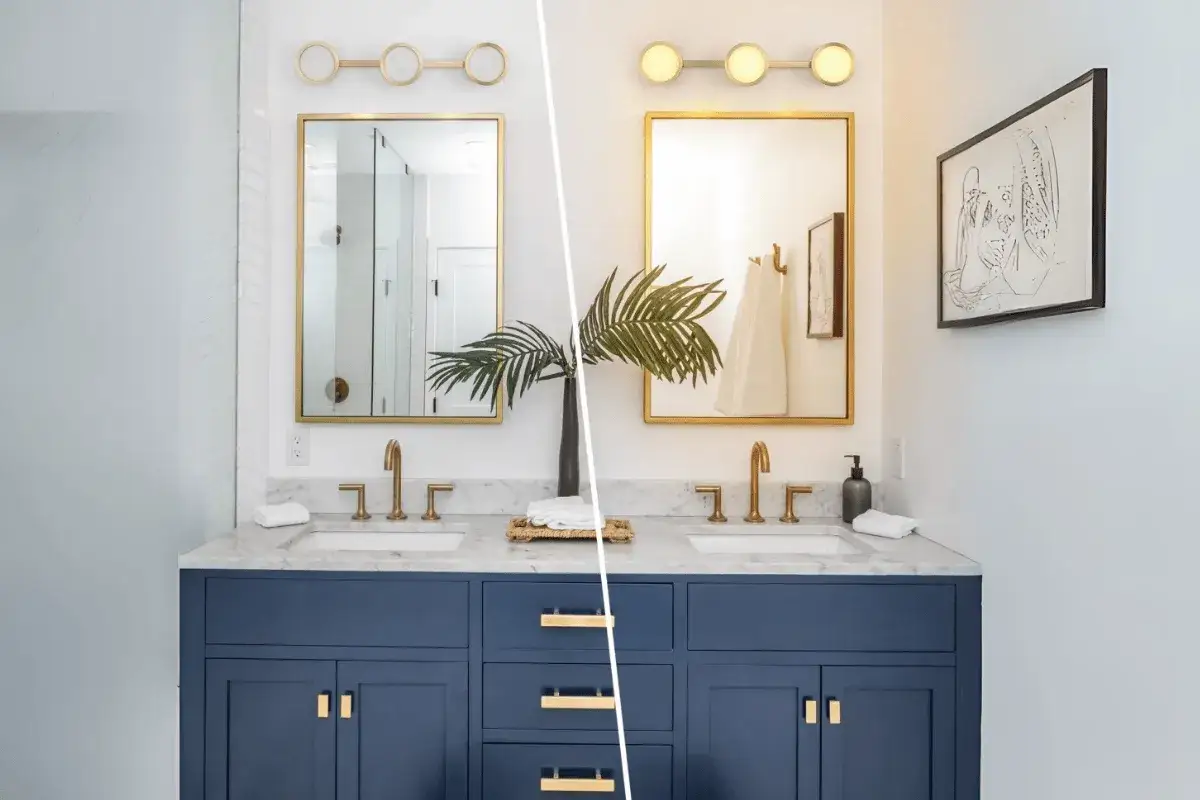
When three lights are worth the extra fixture
Three lights earn their place when the mirror is wider, the vanity is the main grooming station, or the room is used by two people at the same time. The extra bulb usually helps carry light toward both ends of the mirror, which is why three-light bars feel more even on 36-inch, 48-inch, and larger vanities. I find them especially useful in bathrooms that do not get much daylight, because they reduce the pressure on one overhead source to do everything.
- Wider single vanities where the fixture needs to visually fill more horizontal space.
- Primary bathrooms where shaving, makeup, and close grooming happen every day.
- Long rectangular mirrors that look empty with a shorter bar.
- Dim rooms where the vanity light is doing most of the practical work.
- Spaces that need a more finished, architectural look without adding side sconces.
I would still be careful not to choose three lights just because more sounds better. If the bar is too short for the mirror or the shades are poorly diffused, you can end up with extra hardware and not much extra performance. That is why sizing matters right after the light count.
How to size and mount it so the fixture looks intentional
I start with proportion, because a badly sized fixture will look wrong even if the bulb count is right. A good rule of thumb is to keep the light around 70% to 80% of the vanity or mirror width. On a 36-inch vanity, that puts you roughly in the 25- to 29-inch range. On a wider vanity, the fixture should grow with it instead of staying compact just because two or three bulbs sounded sufficient.| Check | Good starting point | Why it matters |
|---|---|---|
| Width | About 70% to 80% of the vanity or mirror width | Keeps the fixture balanced instead of oversized |
| Height | Centerline around 75 to 80 inches from the floor, or a few inches above the mirror | Helps the light land on the face instead of bouncing too high |
| Centering | Align with the sink and plumbing, not just the wall | Places light where the daily task actually happens |
| Clearance | Leave breathing room for mirror edges and any opening cabinet doors | Prevents awkward collisions and a cramped look |
If the mirror is unusually tall, I will sometimes let the fixture sit a touch higher, but not so high that it starts washing the ceiling instead of the face. And if the vanity has a medicine cabinet, I always check the opening arc before I buy. That kind of detail sounds small, but it is exactly what separates a fixture that feels built in from one that feels like an afterthought.
The light quality details that change the result more than people expect
The fixture count only matters if the light itself is pleasant to use. I prefer warm-neutral bulbs in the 2700K to 3000K range, and I avoid harsh clear shades unless the bulb is heavily diffused. A high-CRI bulb also makes a real difference, because skin tones and makeup look more accurate under it. If the vanity is used at different times of day, a dimmer is worth the small extra cost. It gives you enough light for shaving or makeup in the morning and a softer level at night without swapping fixtures.
- Bulb temperature: 2700K feels softer; 3000K reads a little crisper without turning clinical.
- CRI: Higher color rendering helps the room look truer and flatter skin tones less.
- Diffusion: Frosted or opal shades usually reduce glare better than bare bulbs.
- Dimming: Useful when the bathroom has to work for both quick mornings and slower evenings.
- Moisture resistance: I prefer a damp-rated fixture in humid baths and anything close to a shower.
- Finish coordination: A finish that echoes the faucet and mirror frame usually feels more deliberate, even in a mixed-metal room.
This is where many people overfocus on adding another bulb when what they really need is better diffusion or a better color temperature. Once those details are right, the remaining choice is mostly about the layout itself.
The choice I’d make for the most common bathroom layouts
For a small powder room, I would choose two lights almost every time. For a standard single vanity around 36 inches wide, I would start with two if the mirror is narrow and the room has other light, then move to three if that fixture has to carry the task lighting on its own. For a wider single vanity, three lights usually give me a cleaner result because they fill the mirror more evenly and feel less like a compromise. If you have a double vanity, I step back and look at each sink as its own zone; that is often a better answer than forcing one shared bar to do everything.
My practical test is simple: if the fixture makes the mirror look balanced, leaves the face evenly lit, and does not crowd the wall, it is the right choice. If I have to keep explaining why a smaller fixture should still work, I already know the room is asking for the larger option or for a different lighting strategy altogether.