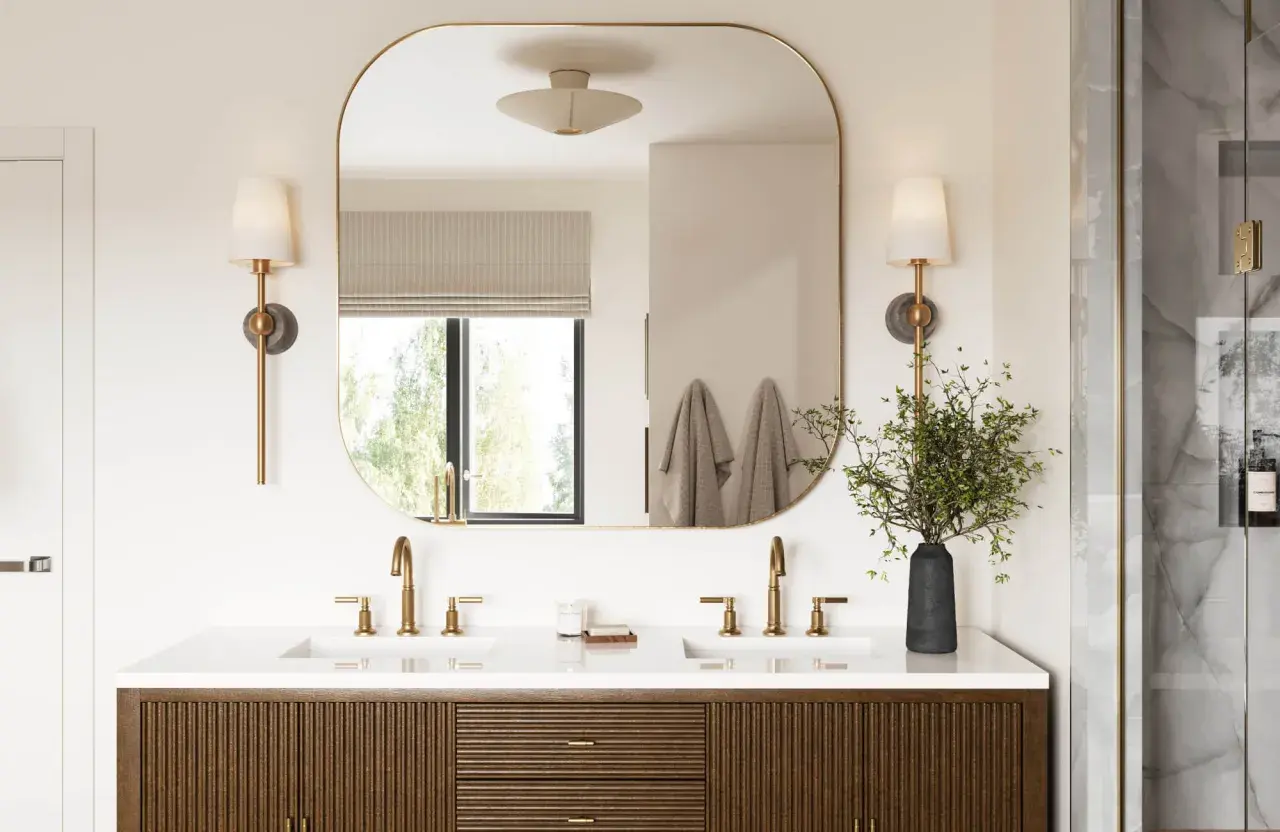
Bathroom mirrors do more than hold a reflection. The right one can pull daylight deeper into the room, reduce harsh shadows at the vanity, and make a compact bath feel less boxed in. I’m focusing here on practical ways of using mirrors to reflect light, along with the fixture choices that make that effect stronger or weaker in a real home.
Key takeaways for a brighter vanity wall
- Mirror placement matters more than decoration. A well-positioned mirror can brighten the room even before you change any other fixture.
- A good starting width is 70 to 80 percent of the vanity. That keeps the mirror proportional without wasting reflective area.
- Center the mirror for the main user. A practical install range is usually around eye level, with enough clearance above the faucet and backsplash.
- Lighting quality is as important as mirror size. I look for high-CRI light so skin tones, finishes, and tile colors read accurately.
- Daylight is the easiest light to improve. If the mirror can catch a window or a bright wall, the whole bath feels more open.
- Storage mirrors solve a different problem than decorative mirrors. Pick the one that matches the room’s real priorities.
Why mirrors change the way bathroom light behaves
I think of a mirror as a light-management surface, not just a decorative panel. A polished mirror creates a strong specular reflection, which means it bounces light in a predictable direction instead of scattering it the way a matte wall does. That is why a mirror can make a vanity wall feel brighter, push daylight deeper into the room, and visually loosen a cramped bath.
The effect is strongest when the room has at least one good source of light to work with. In a windowed bath, the mirror can extend daylight. In a darker bath, it can make sconces or a vanity light bar feel more effective. The trade-off is simple: a mirror also amplifies whatever it faces, so clutter, glare, and a poor view become part of the design.
- Brighter task zone: faces are easier to see for shaving, skincare, and makeup.
- Bigger visual field: the room feels wider because the eye reads depth where there is only reflection.
- Fewer dead corners: reflective surfaces help pull light into spots that ceiling fixtures often miss.
That is why I usually start with function before style. Once you understand what the mirror is doing with light, size and placement become much easier to judge.
How to size and place the mirror for the most bounce
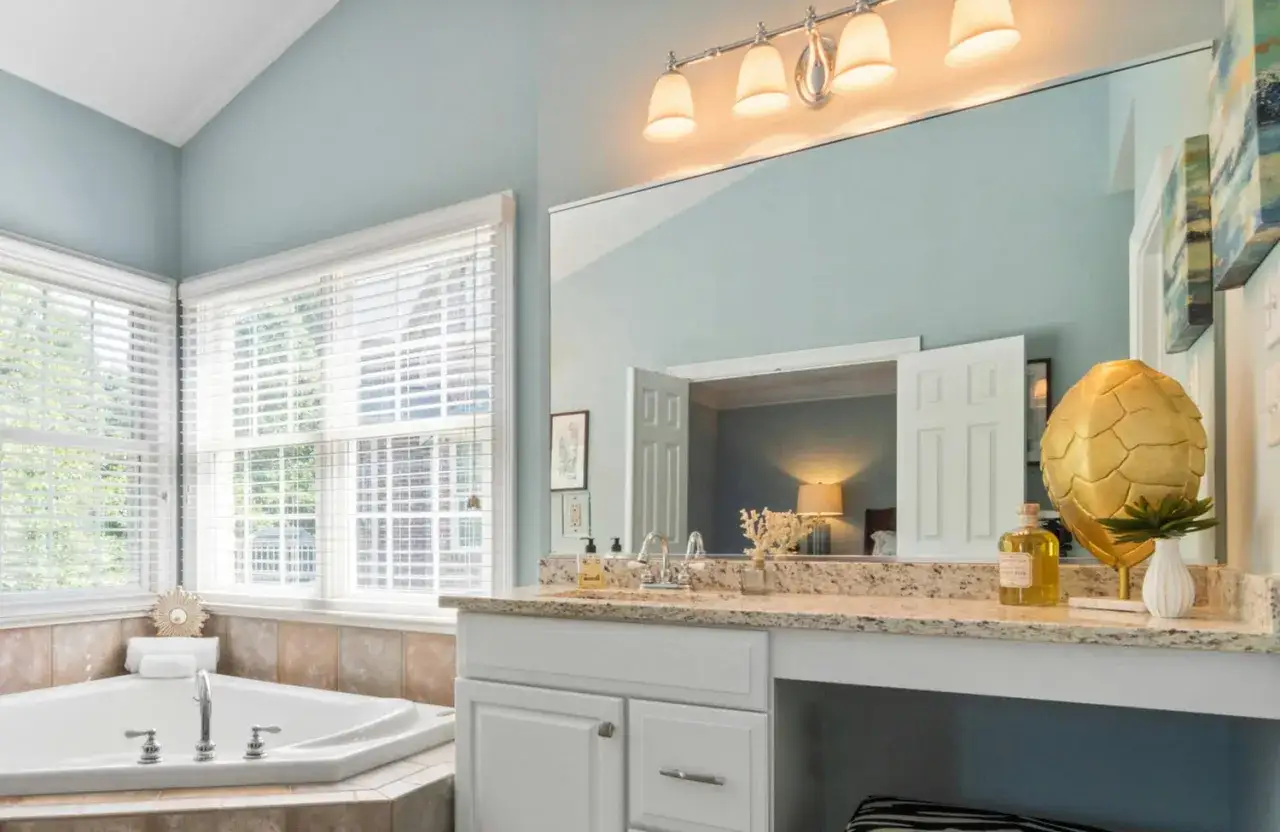
A mirror can be beautiful and still fail if the proportions are off. For a standard single vanity, I usually start with a mirror that is about 70 to 80 percent of the vanity width. That leaves a little visual breathing room while still giving you enough reflective surface to make a real difference. If the mirror is too narrow, the wall feels chopped up and the light payoff drops fast.
Height matters just as much as width. A practical install range puts the center of the mirror around eye level for the main user, and many bathrooms land somewhere around the low 60-inch range from the finished floor. I also like to leave enough space above the faucet and backsplash so the mirror does not feel squeezed into the wall. When the sink is tall, the faucet is deep, or the vanity is custom-built, I adjust from the room rather than forcing a standard template.For double vanities, I decide early whether the goal is personal zones or a more open wall. Two separate mirrors keep the space organized and usually work better for couples who need clear sightlines. One long mirror creates a cleaner reflective plane and can brighten the room more aggressively. Neither option is universally better; the right choice depends on whether storage, symmetry, or maximum light matters most.
- Single vanity: use a mirror that is slightly narrower than the countertop so the wall feels balanced.
- Double vanity: choose one wide mirror for openness or two mirrors for clearer individual use.
- Wall sconces: leave enough edge space so the lights do not crowd the mirror frame.
- Vessel sinks or tall faucets: move the mirror up only as much as the fixture layout requires.
I always check what the mirror will actually reflect before I commit. If it bounces back a window, a clean backsplash, or a good fixture, it earns its place. If it mostly shows a cluttered shelf or a toilet tank, I rethink the layout.
Which mirror styles work best in bathrooms
Different mirror shapes handle light differently, and in a bathroom that matters more than people expect. The best choice depends on whether you want the widest possible field of reflection, a softer look, or extra storage. Here is how I usually compare the common options.
| Mirror type | Best for | How it handles light | Main trade-off |
|---|---|---|---|
| Frameless rectangle | Everyday grooming and maximum brightness | Gives the largest usable reflective area and the cleanest bounce | Can feel plain if the rest of the room lacks character |
| Round mirror | Softening a room with hard lines | Spreads light well and makes the vanity wall feel lighter | Less reflective area at the corners |
| Arched mirror | Small bathrooms that need vertical lift | Draws the eye upward and adds a sense of height | Can reduce side reflection near wall lights |
| Medicine cabinet mirror | Storage-first bathrooms | Reflects light while hiding products and clutter | Usually bulkier and needs more install planning |
| LED or backlit mirror | Shadow-prone vanities and modern remodels | Provides even face light and can reduce harsh glare when well made | Quality varies widely, and installation can be more involved |
For pure light reflection, I almost always favor a simple rectangle. It gives you the most usable surface and keeps the room visually calm. Round and arched mirrors are excellent when style matters more, but they are usually a little less efficient at reflecting light across the whole wall.
In family baths, a recessed medicine cabinet can be the smartest compromise because it handles storage and reflection at the same time. In a powder room, a bold shape can work well if the room already has enough light and the mirror is being asked to do less heavy lifting.
Pairing the mirror with vanity lighting
This is where most bathrooms either get polished or fall apart. A mirror cannot fix poor lighting; it can only redistribute it. In most U.S. homes, the best vanity setup comes from layering light instead of relying on a single ceiling fixture.
I usually look for three things: even face light, accurate color, and control over glare. The Department of Energy treats color rendering as a real lighting-quality issue, and I agree. For a vanity wall, a high-CRI LED matters because it shows skin tones, finish colors, and tile tones more faithfully. For most bathrooms, I am comfortable starting around 3000K to 3500K for a balanced feel; warmer tones are softer, while cooler tones can feel crisp but sometimes a little clinical.
- Side lighting: sconces at about face height usually reduce shadows better than a lone light above the mirror.
- Above-mirror bars: useful when wall space is tight, but they can create under-eye shadows if they are the only source.
- Integrated LED mirrors: good for compact spaces, as long as they are dimmable and paired with room lighting.
- Diffused lenses: frosted covers and soft edges help prevent the mirror from throwing back harsh points of light.
If I am designing for grooming first, I prefer a mirror-light combination that lights the face evenly from both sides or from a broad, softly diffused source. If I am designing for mood, I can lean warmer and softer, but I never let atmosphere replace basic visibility at the vanity.
Use daylight, but control what the mirror sends back
Lowe's makes a simple but important point: a mirror opposite a window can act like a second opening. I use that trick often in smaller baths because it is one of the cheapest ways to make a room feel more open. If the window is the strongest light source in the room, the mirror should help move that brightness deeper into the space instead of trapping it at the glass.
The best reflections are usually the ones that look intentional. A light-painted wall, a clean backsplash, a window with decent exterior light, or even a neatly styled sconce can all improve the room. The worst reflections are clutter, a toilet tank, open storage packed with bottles, or a direct line of sight to an awkward corner. A mirror should help the room breathe, not multiply every visual annoyance.
- Good target: natural light from a window or a bright adjacent wall.
- Good secondary target: tile, trim, or a fixture with a clean silhouette.
- Avoid: direct sun beams, busy shelves, and obvious clutter.
- Watch for: glare from glossy tile or a bright lamp aimed straight at the glass.
I also pay attention to privacy and comfort. A mirror that reflects a view into the shower zone or out toward a neighboring building can feel exposed fast. Brightness is useful; visual control is what makes the room feel finished.
Match the mirror to the rest of the fixtures
Bathroom mirrors live in a fixture ecosystem. Faucets, sconces, medicine cabinets, cabinet pulls, backsplash material, and even towel bars all affect how the mirror reads. When those pieces speak the same design language, the room feels intentional. When they fight each other, the mirror starts to look like an afterthought.
I like to think in terms of finish coordination rather than perfect matching. A polished chrome faucet does not require a chrome-framed mirror, but the frame should not look alien next to the sink hardware either. A matte black frame can work beautifully with black sconces and a simple white vanity. Brass reads warmer and more decorative, so it usually wants at least one other repeat in the room.
- Frameless mirrors: best when the vanity, backsplash, and lighting already have clean architectural lines.
- Thin metal frames: useful when you want the mirror to echo the faucet finish without overpowering the wall.
- Heavy decorative frames: better in larger bathrooms where the frame will not steal too much reflective area.
- Recessed medicine cabinets: the cleanest choice when storage matters more than a decorative statement.
Moisture resistance also matters more than many buyers expect. In a humid bath, a poor backing can stain, fog, or edge out over time. If the mirror is near a shower or used in a busy family bath, I pay extra attention to sealed edges, durable hardware, and any anti-fog feature that might actually earn its cost.
Common mistakes that make mirrors work against you
Most mirror mistakes are not dramatic. They are just small misjudgments that quietly reduce the room’s light and comfort. The good news is that almost all of them are easy to avoid once you know what to look for.
- Choosing a mirror that is too small: it chops up the wall and weakens the reflective effect.
- Hanging it too high or too low: sightlines get awkward, and the useful portion of the mirror shrinks.
- Reflecting clutter: open shelves and product chaos become part of the room’s visual load.
- Overusing mirrored surfaces: mirrors facing mirrors can create a disorienting corridor effect.
- Ignoring glare: bright bulbs or glossy tile can bounce light into the eyes instead of across the room.
- Prioritizing style before function: a beautiful frame cannot rescue bad placement or weak lighting.
I also see people underestimate daily maintenance. A very dark frame, a high-gloss finish, or an over-ornate edge can look great in photos and fussy in real life. In a bathroom, the easier the mirror is to clean and live with, the better the design usually ages.
The three choices I would make before buying anything
If I were starting a bathroom update from scratch, I would make three decisions before I looked at finish samples or trendier shapes. First, I would decide what the mirror should reflect. Second, I would decide whether storage or openness matters more. Third, I would decide whether the mirror or the lighting will carry most of the brightness.
- Choose the reflection first: window, clean wall, or attractive fixture.
- Choose the function second: grooming, storage, or visual expansion.
- Choose the light source third: sconces, a light bar, or an integrated LED mirror with a separate ambient layer.
When those three choices are clear, the rest of the project gets easier. The mirror stops being a generic accessory and starts doing real work for the room. That is the part I care about most: not just more light, but better light in the places the bathroom actually needs it.