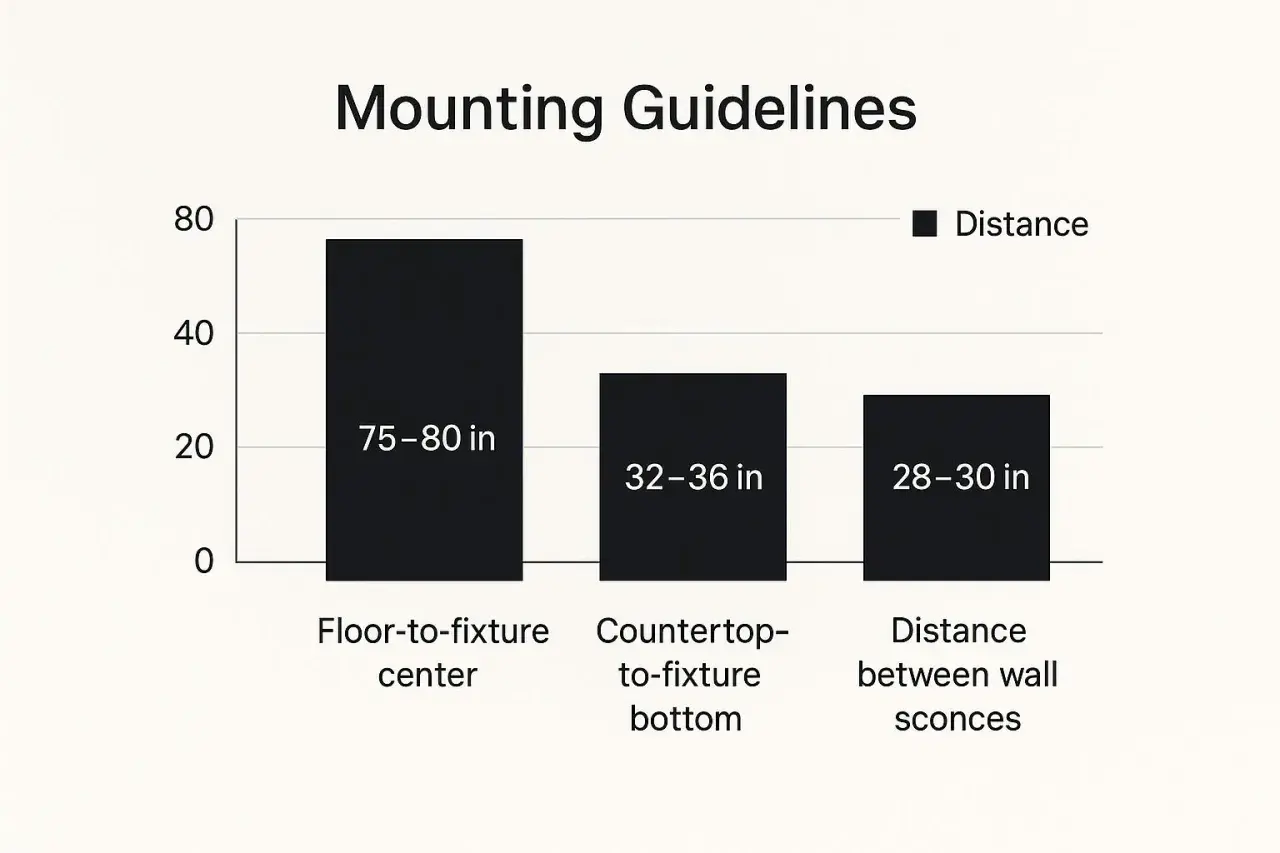
The right vanity light height is less about one magic number and more about where the light lands on the face. Get it wrong, and even a well-designed bathroom can feel dim, harsh, or awkward around the mirror. I usually start with placement first, then fine-tune the fixture style, mirror size, and the way the room is used.
What to know before you mount a bathroom vanity light
- For a light bar above the mirror, a strong starting point is 75 to 80 inches from the finished floor.
- For side sconces, eye level is the goal, which usually means about 60 to 66 inches from the floor.
- Measure from the finished floor, not from the countertop, faucet, or cabinet top.
- If the mirror is tall, keep the light centered for face coverage instead of forcing it into a fixed gap.
- Side lighting usually gives the most flattering grooming light, while an above-mirror bar is easier in tighter spaces.
- Choose damp-rated fixtures and consider a dimmer if the bathroom handles both quick mornings and slower evening routines.
The height that works in most bathrooms
When I am setting the first mark on the wall, I usually start with the fixture center at 75 to 80 inches from the finished floor for an above-mirror bar. That range keeps the light close enough to the face to reduce shadows without pushing the fixture so high that it becomes decorative instead of useful.
A practical shortcut is to think in relation to the mirror itself: a bar often ends up roughly 6 to 8 inches above the top edge of the mirror in a standard bathroom. That gap gives the light room to spread evenly across the face and keeps the mirror from feeling visually crowded.
I also prefer to measure from the finished floor every time, not from the vanity top or faucet. That keeps the layout consistent if the plumbing changes, the countertop is replaced, or the mirror gets swapped later. Once that baseline is set, the next question is whether the light belongs above the mirror or on either side of it.How I position a light bar above a bathroom mirror
An over-mirror light bar works best when it is centered over the sink and mirror, not just visually centered on the wall. That alignment matters because task lighting should land where your face actually is, especially when you are shaving, doing makeup, or checking detail in the mirror.
| Fixture type | Typical mounting height | Best use | Tradeoff |
|---|---|---|---|
| Above-mirror light bar | 75 to 80 inches from the finished floor | Small to medium bathrooms, simple retrofits, single centered source | Can create facial shadows if it is the only light source |
| Side sconces | 60 to 66 inches from the finished floor | Grooming, makeup, and flatter face lighting | Needs wall space and clean symmetry |
| Lighted mirror | Follow the manufacturer’s spec | Minimalist bathrooms or tight wall layouts | Less flexible after installation |
For size, I like a light bar that feels proportionate to the mirror rather than oversized. In most bathrooms that means a fixture that is clearly narrower than the mirror or vanity cabinet, with enough visual presence to anchor the wall but not so much that it overwhelms the glass. That balance becomes even more important when you have a wider mirror or a double sink, which is where side lighting sometimes wins outright.
That decision matters because the wrong fixture style can make a good height choice feel wrong even if the measurements are technically correct.
When side sconces give a better result
If there is room on the wall, side sconces are often the most flattering choice for personal grooming. They place light closer to eye level, which helps soften shadows under the eyes, nose, and chin. For makeup application especially, that difference is easy to feel the first time you use the mirror.
The useful range is usually 60 to 66 inches from the finished floor, with the light source centered around eye level. That keeps the fixture high enough to avoid glare while still aiming the light where it matters. I also like to keep the pair visually even on both sides of the mirror; if one side sits higher than the other, the room starts to feel off balance very quickly.
For a typical single vanity, a pair of sconces often lands about 36 inches apart, though mirror width and wall layout can move that number. If the mirror is wide, the sconces may need to sit farther out; if the wall is tight, a top-mounted light may be the cleaner solution. The point is not to force symmetry at the expense of usefulness.
In bathrooms where people spend more time getting ready, I usually lean toward side lighting over a single top bar. That choice still changes with the mirror, the ceiling, and the way the bathroom is used.
How mirror size, ceiling height, and daily use change the answer
Bathroom lighting is more forgiving than people think, but it is not one-size-fits-all. A tall mirror, a low mirror, a compact powder room, and a primary bath with a double vanity all want slightly different solutions. The safest approach is to start with the face, then let the architecture confirm the final height.
Here is how I adjust the plan in real projects:
- Taller mirrors: keep the light high enough to clear the glass, but do not chase the mirror upward so far that the fixture stops lighting the face.
- Higher ceilings: do not automatically mount the fixture higher just because the room is taller. If the light stops hitting eye level well, the extra height is not helping.
- Children’s bathrooms: I usually keep the standard mounting height and let the mirror be adjustable instead of lowering the light too much.
- Double vanities: I prefer separate lighting over each sink so each user gets balanced light instead of sharing one compromise.
- Makeup or grooming-heavy use: brighter, more even light matters more than a decorative fixture shape.
Brightness matters here too. For a vanity zone, I like enough output to feel crisp without being harsh, and I prefer putting that light on a dimmer so the room can shift from task mode to softer evening use. A warm-neutral LED with good color rendering usually makes skin tones look more natural than a cool, blue-leaning bulb.
Even when the height is right on paper, a few installation mistakes can undo the effect.
The mistakes that make the setup feel off
The most common problem is mounting the fixture too low. That tends to throw awkward shadows on the face and can make the mirror feel cramped, especially when the light bar sits almost on top of the glass. Too high creates the opposite problem: the fixture looks balanced from across the room, but the light starts missing the face where it matters.
- Measuring from the countertop instead of the finished floor: this is the fastest way to end up with a placement that looks fine on paper and wrong in the room.
- Centering on the wall instead of the sink: if the sink is off-center, the lighting should still serve the user, not just the drywall grid.
- Using a fixture that is too wide: a bar that exceeds the mirror or cabinet width can make the whole vanity look clumsy.
- Ignoring the fixture depth: a chunky sconce can project too far and feel intrusive even if the height is perfect.
- Skipping the moisture rating: in a bathroom, damp-rated is the safer baseline, and areas closer to showers or frequent spray may need a higher rating.
I also see people overvalue style and undervalue beam spread. A sculptural fixture can be beautiful, but if it leaves the lower half of your face in shadow, it is not doing its job. Once those mistakes are out of the way, the final check becomes much simpler and much more reliable.
The rule set I would use before drilling
If I were laying out a bathroom today, I would use a short checklist and then trust what the room tells me. First, I would mark the centerline of the sink or mirror. Next, I would set an above-mirror light bar at about 75 to 80 inches from the finished floor, or place side sconces at about 60 to 66 inches from the floor if the wall has room. After that, I would step back and check the mirror at standing height, because that is where the real test happens.
- Confirm the fixture is centered on the sink or balanced evenly as a pair.
- Check that the top of the mirror still has visual breathing room.
- Make sure the light lands on the face, not just the forehead or ceiling.
- Verify the fixture is damp-rated for bathroom use.
- Use painter’s tape or a cardboard mockup before drilling if the wall layout is tight.
If I had to reduce the whole decision to one idea, it would be this: put the light where it flatters the face first, then let the mirror and wall composition support it. In most U.S. bathrooms that means starting with 75 to 80 inches for a top bar or 60 to 66 inches for side sconces, then adjusting slightly for mirror height, user height, and the amount of task lighting the room really needs.