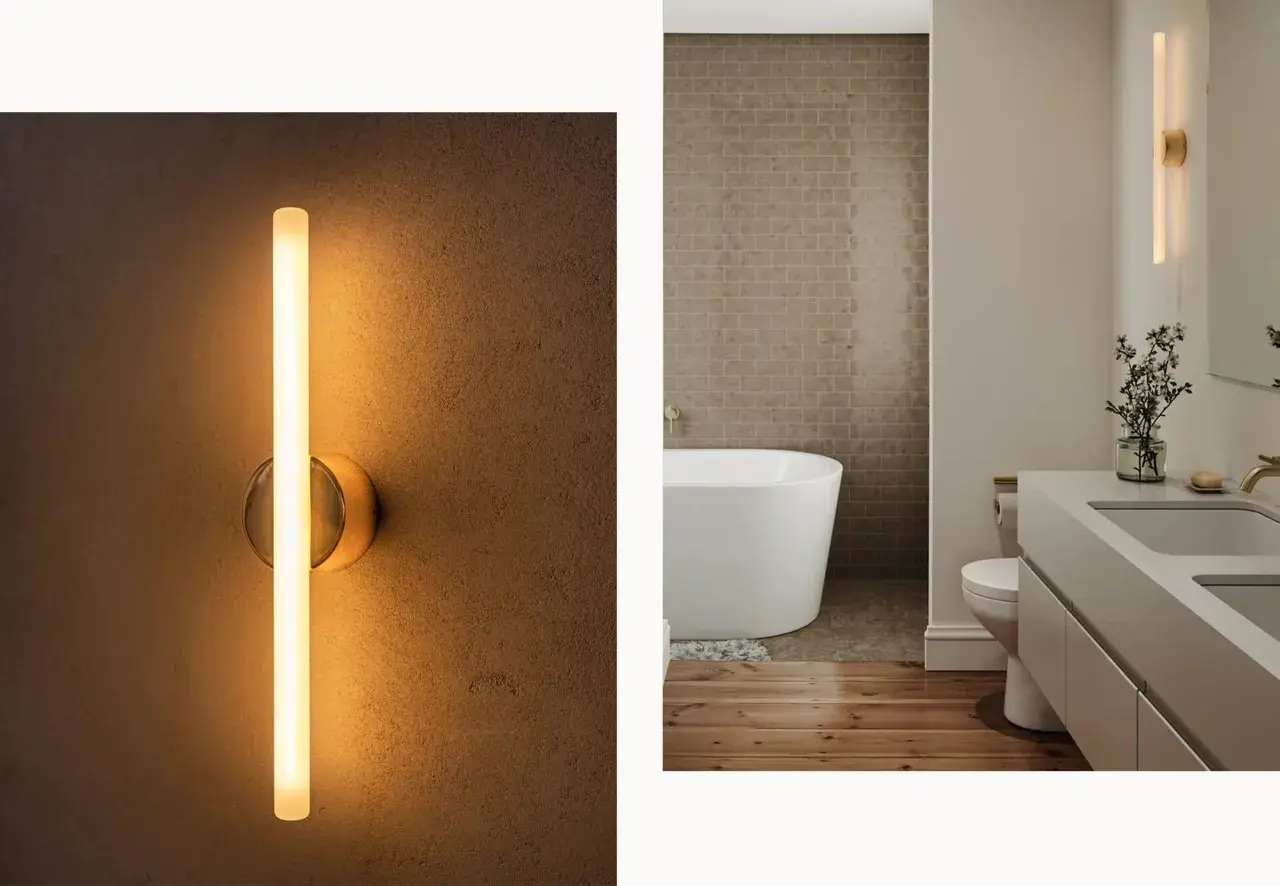
In a bathroom, wall sconces are less about fashion and more about whether the light flatters faces, works with the mirror, and fits the room’s proportions. Are wall sconces out of style? Not really. What has changed is the way designers use them: in 2026, they are usually part of a layered lighting plan instead of a standalone statement. I still see them making bathrooms feel warmer, calmer, and more finished than a room lit only by an overhead fixture.
What matters most before you replace the vanity lights
- Wall sconces still feel current when they are simple, well scaled, and matched to the bathroom’s finish palette.
- They look dated mainly when they are undersized, overly ornate, or placed at the wrong height.
- Side sconces beside a mirror usually give the most flattering face light.
- In tight bathrooms, a mirror light bar or backlit mirror can be the better choice.
- Damp-rated fixtures and proper spacing matter as much as style.
Why wall sconces still feel current in bathrooms
I do not read wall sconces as a relic at all. In a bathroom, they solve a real problem: overhead light alone creates shadows under the eyes, nose, and chin, while side-mounted light softens the face and makes daily routines easier. That is why sconces keep showing up in well-designed baths, especially where the goal is a quieter, spa-like mood instead of a bright utility-room look.
They also fit the direction bathroom design has taken over the last few years. Warm metals, softer glows, textured stone, and layered lighting all favor fixtures that feel integrated rather than loud. A simple sconce can do a lot here because it adds structure around the mirror without taking over the room. When the mirror, vanity, and hardware are already doing their job, a wall light becomes the thing that makes the whole composition feel intentional.That said, the fixture only works if it belongs to the room. The next question is not whether sconces are fashionable, but when they start to look like a leftover from a bad remodel.
When wall sconces start to look dated
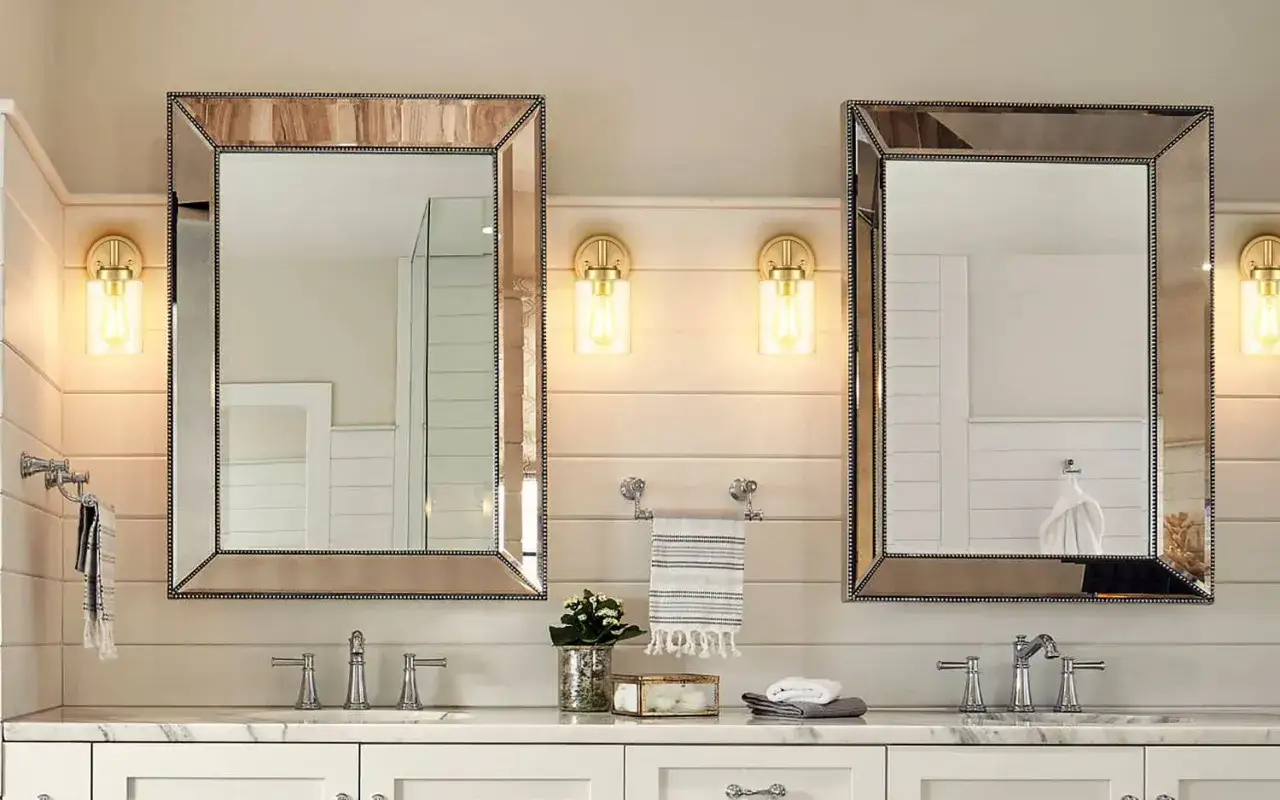
A bathroom sconce usually looks dated for one of three reasons: the shape is fussy, the scale is wrong, or the placement is careless. The most obvious offender is the old Hollywood-style vanity row, where multiple exposed bulbs sit over a mirror and throw harsh, flat light. It can be bright, but it rarely feels refined.
- Too much ornament: scroll arms, fake crystal, or overly decorative shades can fight modern tile and cabinetry.
- Wrong finish: a shiny, builder-grade chrome fixture can read cold if the rest of the room uses warmer materials.
- Poor proportions: a tiny sconce beside a large mirror looks accidental, while a fixture that hangs too far out can crowd the vanity.
- Bad height: when the light sits too high, it lights hair and forehead more than the face; too low, and it creates ugly downward shadows.
- Overcomplicated room mix: if the bathroom is minimal, a highly traditional sconce can feel pasted on instead of planned in.
I usually think of this as a proportion problem, not a style problem. A well-chosen sconce can survive changing trends; a poorly scaled one will look tired almost immediately. Once you know the traps, choosing a better-looking fixture becomes much easier.
How to place sconces so they look intentional
Placement matters as much as the fixture itself. For most bathrooms, I prefer side sconces mounted roughly at eye level, with the center of the light somewhere around 65 to 70 inches from the floor. That range usually gives even face light without making the mirror feel crowded. If you are using two sconces, keep them close enough to frame the mirror rather than floating far out toward the vanity edges.
As a practical rule, side sconces tend to work best when the mirror is not oversized. A very wide mirror can push the fixtures so far apart that they stop helping the face and start acting like decorative objects. In narrower baths, I will often choose a single light over the mirror or a slim pair positioned to suit the wall width. If the ceiling is low, keeping the lights tight to the mirror also helps the room feel less top-heavy.
There is one technical detail I never skip: bathroom fixtures need the right rating. Damp-rated lights handle humidity, while wet-rated fixtures are built for direct water exposure. That distinction matters more than people think, especially in a bath with a shower close to the vanity.
Good placement is what keeps a sconce from feeling ornamental for the sake of it. Once that part is right, the style choices become much easier to judge.
The styles that feel fresh in 2026
In 2026, the sconces that feel current are usually the ones that are visually quiet but materially rich. I keep seeing a preference for brushed brass, matte black, soft white glass, and forms that look edited rather than decorative. The goal is not to make the fixture invisible; it is to make it feel like part of the architecture.
- Slim cylindrical sconces: clean lines, easy to pair with modern tile, and less likely to compete with a statement mirror.
- Opal or frosted glass shades: they soften the light, which is useful in bathrooms where harsh glare ages the room fast.
- Warm metal and clear glass combinations: these work when the vanity has visible hardware and you want the light to echo that finish.
- Minimal swing-arm sconces: practical for powder rooms or side-mirror placements, especially when you want the fixture to adjust the beam.
- Simple sculptural forms: slightly more decorative, but still restrained enough to read as design-forward instead of trendy.
I would be cautious with anything that feels too precious. A bathroom is humid, reflective, and used every day. The best sconce design is the one that looks polished in daylight, under evening light, and in a mirror full of toothpaste splashes. That is a much better test than whether it merely looks good in a showroom.
Wall sconces versus other bathroom lighting options
When I am deciding between sconces and another fixture type, I look at mirror width, ceiling height, and how much visual calm the room needs. The right answer changes from bathroom to bathroom, which is why a comparison helps more than a blanket rule.
| Option | Best for | Why it works | Where it falls short |
|---|---|---|---|
| Side wall sconces | Primary baths and powder rooms with enough wall space beside the mirror | Flattering face light, balanced composition, easy to style with the vanity | Can look cramped on a wide mirror or a very narrow wall |
| Over-mirror light bar | Compact bathrooms or mirrors that run nearly wall to wall | Simple to install, clean look, good if side clearance is limited | Can create more top-down shadow than side lighting |
| Backlit mirror | Minimal, spa-like bathrooms | Soft ambient glow, little visual clutter, very current in 2026 | May not provide enough task light on its own |
| Recessed ceiling lights alone | Utility-focused spaces or very small baths | Bright and straightforward | Usually the least flattering option if used by itself |
| Pendant lighting | Rooms with extra ceiling height and a decorative focus | Can feel custom and architectural | Often impractical near the vanity unless the room is generously sized |
My own rule is simple: if the bathroom needs better face light and has room to spare, I lean toward sconces. If the room is tight or the mirror is already the main feature, I would rather use a cleaner alternative than force a pair of fixtures onto the wall.
When the upgrade is worth it and what it usually costs
Sometimes the right move is not a full lighting redesign. If the bathroom already has decent wiring and the only problem is a tired finish or poor light quality, a sconce swap can be one of the quickest ways to make the room feel newer. That is especially true in bathrooms where the tile, vanity, and mirror still work, but the light makes everything look flat or yellow.
For budgeting, professional wall sconce installation currently averages about $250 per fixture, with a common range of $150 to $550 depending on wiring, wall repairs, and fixture complexity. If the project needs new wiring, a dimmer, or patching behind the wall, the cost climbs quickly. That is why I usually tell people to decide whether they are making a cosmetic update or starting a more serious electrical change. The answer determines whether a simple fixture swap is enough.
If you are keeping the layout, spend on a fixture that is damp-rated, well made, and dimmable. If you are changing the mirror or vanity at the same time, step back and recheck the proportions first. Lighting is one of those details that can rescue a bathroom, but only when it is coordinated with the rest of the room.
The bathroom choices I would make first
If I were updating a bathroom in 2026, I would not start by asking whether sconces are trendy. I would ask what the room needs: softer face light, a calmer mood, or a more balanced wall around the mirror. That usually points to one of three moves. In a compact bath, I would choose a clean over-mirror fixture or a backlit mirror. In a primary bath with enough width, I would use a pair of simple sconces in brass, black, or soft white glass. In a powder room, I would treat the sconce as a small design moment and keep the rest of the room restrained.
The design lesson is straightforward. Wall sconces are not out of style; badly chosen ones are. When the scale is right, the finish feels connected to the room, and the light lands where people actually use it, the fixture looks intentional rather than dated. That is the difference I keep coming back to in bathroom projects: not whether the sconce is trendy, but whether it makes the room easier to live with every day.