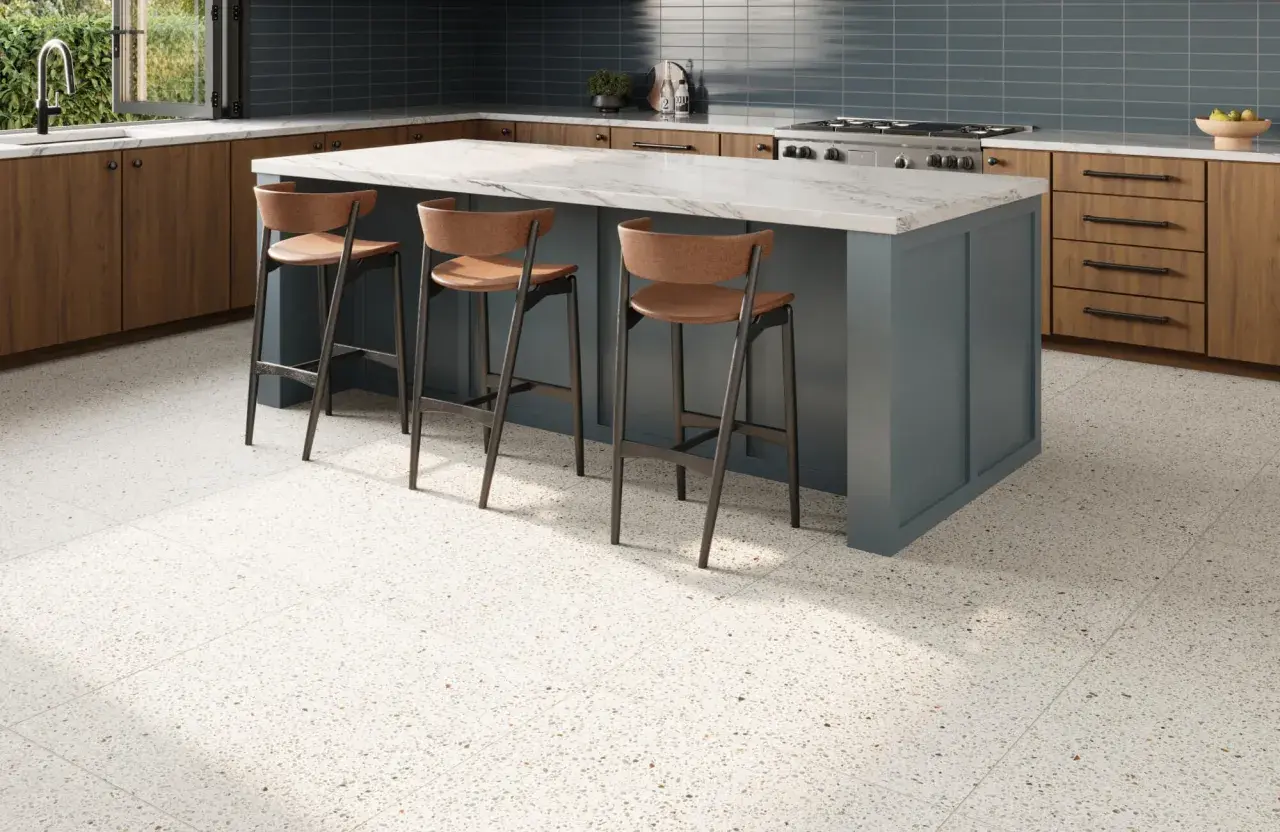
I treat terrazzo-style flooring as a surface decision, not just a pattern choice. The right version has to handle water, clean easily, and still give a bathroom or entryway some character without turning the room noisy. This guide breaks down how Bella Terrazzo performs as a flooring choice, where it works best, what to ask for in a spec sheet, and how much you should expect to spend in the U.S.
The practical takeaway on terrazzo-look flooring
- A terrazzo-look porcelain tile gives you the visual effect with less upkeep than poured terrazzo.
- For wet bathrooms, I would want a matt or grip finish and a wet DCOF, or dynamic coefficient of friction, of at least 0.42.
- Large-format tiles need a flatter substrate; for edges 15 inches and longer, 1/8 inch in 10 feet is the benchmark I keep in mind.
- In the U.S., poured terrazzo usually lands around $20 to $50 per square foot installed, while terrazzo tile is often $15 to $35 per square foot installed.
- Neutral grout and a restrained wall palette keep the floor from feeling busy.
What this terrazzo look actually gives you
I would describe it as a controlled, modern version of terrazzo. Instead of the fully custom, poured surface you get with traditional terrazzo, the look is captured in a manufactured tile, which means more predictable color, easier ordering, and far less uncertainty on site.
One example I found is a 600 x 600 mm porcelain series in Sabbia, Grigio, and Bianco with a 10 mm body and matt or Smart Grip finishes. That combination tells me the product is meant to function as a real floor, not just a decorative accent, and that matters if you want something that can move from a bathroom to a hallway without changing character.
The biggest advantage here is balance: you get speckle, depth, and movement, but you do not get the maintenance burden or budget shock of a custom poured floor. That tradeoff is why the style keeps showing up in residential bathrooms and compact spaces where a little pattern goes a long way. Once you understand that, the next decision is where the floor will actually be asked to perform.
Where it works best in a home
I think this look is strongest anywhere the floor needs to do two jobs at once: perform well and carry some design weight. Bathrooms are the obvious use case, but powder rooms, laundry rooms, mudrooms, and kitchen floors can all benefit if the rest of the room is kept calm.
| Space | My take | Why |
|---|---|---|
| Primary bathroom | Strong fit | It handles water well when the finish and slip rating are right, and the pattern adds interest without needing color everywhere. |
| Shower floor | Use with caution | Only for the right texture and a well-detailed slope; this is not the place for glossy or overly smooth tile. |
| Powder room | Excellent fit | A small footprint makes the speckle feel intentional rather than busy. |
| Laundry or mudroom | Very practical | It hides lint, grit, and everyday traffic better than a flat solid color. |
I would hesitate in rooms where the walls, vanity, backsplash, and floor are all trying to compete. Terrazzo works best when it is the one element carrying texture, not one more pattern in a room already doing too much. Once the room is right, finish and format become the real filter.
How to choose the right finish, format, and grout
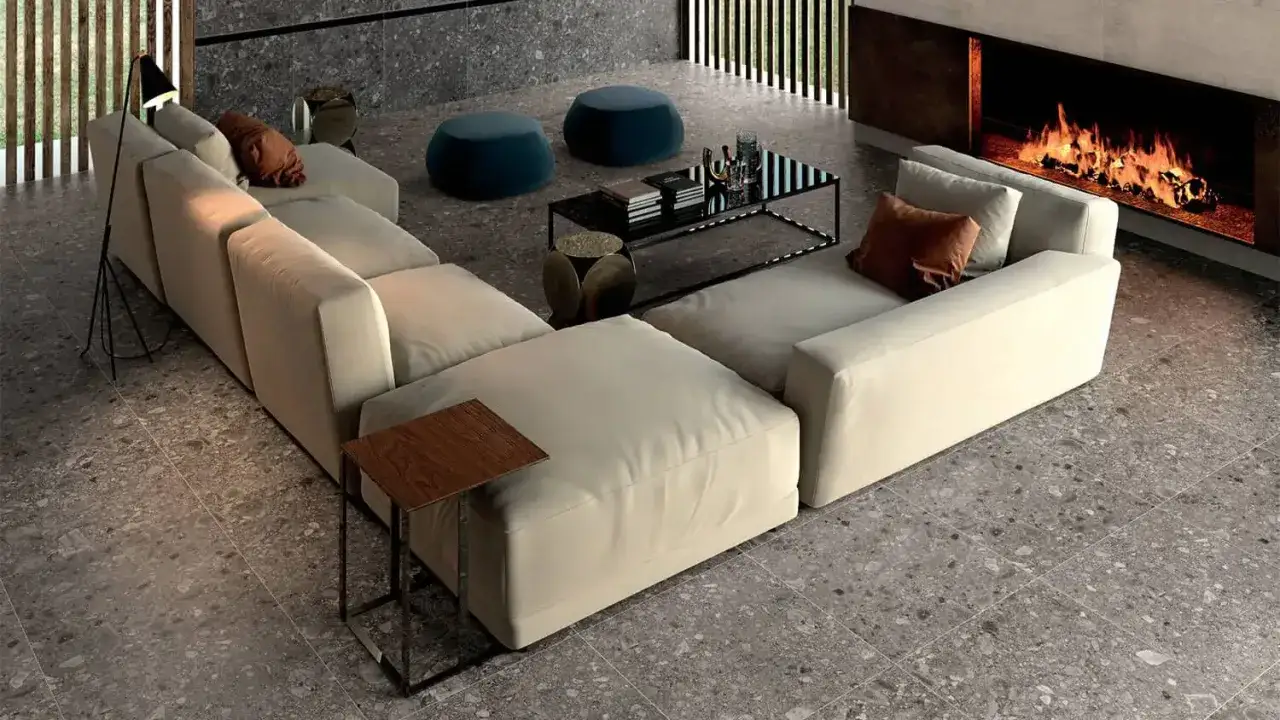
For bathrooms, I lean hard toward a matt or lightly textured finish. Gloss makes water spots louder and can make the floor feel more slippery than it should.
The number I look for in the U.S. is a wet DCOF, or dynamic coefficient of friction, of 0.42 or higher for interior spaces expected to be walked on when wet. That is not a promise of safety, and it is definitely not the same as slip-proof, but it is the baseline I want before I get interested in a floor tile for a bathroom or shower area.
Format matters just as much. A 600 x 600 mm tile, roughly 24 x 24 inches, is a sweet spot because it keeps the floor readable without creating a busy grid. If the room is tiny, I still prefer larger tiles over tiny fragments, but I would keep the cuts symmetrical so the layout feels deliberate.
Grout color is the quiet detail people underestimate. I usually match it closely to the background tone so the floor reads as a field, not a grid. On a busy terrazzo pattern, a high-contrast grout line can steal the whole room.
Those choices only work if the installation is handled with equal care, because a good-looking tile can still fail visually when the substrate or layout is off.
Installation details that matter more than the pattern
Terrazzo-look tile can be forgiving visually, but it is not forgiving structurally. A good install starts with a sound substrate, proper waterproofing in wet zones, and movement joints where the floor needs room to breathe. If those are wrong, the floor can fail even when the tile itself is excellent.- Check substrate flatness before tile goes down.
- Use a waterproofing membrane in showers and other wet rooms.
- Ask for movement joints at perimeters and where the room changes plane.
- Use the right thin-set mortar for the tile size and setting conditions.
- Keep grout joints consistent so the speckled field does not look crooked.
For tiles with at least one edge 15 inches or longer, I plan around a maximum 1/8 inch variation in 10 feet. That is the kind of detail that separates a crisp floor from one that looks wavy once the light hits it. In shower floors, I usually step down to a smaller module or mosaic because the slope is easier to manage and the tile follows the pan more naturally.
After that, upkeep is the part that decides whether the floor stays elegant or just looks expensive on day one.
Maintenance is easier than real terrazzo, but not maintenance-free
This is where the porcelain version earns its keep. Traditional terrazzo usually wants regular dust mopping, damp mopping with a neutral cleaner, and occasional resealing depending on the matrix and use. Porcelain does not need that kind of upkeep, which is a major reason I favor it for residential bathrooms.
For day-to-day care, I would keep it simple: sweep or vacuum grit, mop with a pH-neutral cleaner, and avoid anything abrasive or waxy. The tile surface itself is tough; the grout is usually the part that shows neglect first.
If you are using the floor in a shower or around a tub, the real maintenance issue is not the speckled tile. It is soap residue, hard-water marks, and poorly dried corners. Those are practical problems, but they are manageable when the room has good ventilation and the tile was installed with the right slope and waterproofing.
The maintenance profile is one reason this finish makes more sense than it first appears to. The last reality check is budget, because the same look can price out very differently depending on which system you choose.
What I would budget for it in the U.S.
When people ask me about terrazzo, I tell them to budget by system, not by square foot alone. The tile price matters, but subfloor work, waterproofing, trims, and labor can change the total more than the product catalog does.
| Option | Typical installed cost | Best for | Main tradeoff |
|---|---|---|---|
| Poured terrazzo | $20 to $50 per sq ft | High-end, seamless, custom interiors | Higher upfront cost and more complex installation |
| Terrazzo tile | $15 to $35 per sq ft | Bathrooms, kitchens, and smaller renovation projects | Grout lines remain visible |
| Terrazzo-look porcelain tile | $12 to $40 per sq ft | Design-led rooms that need easier maintenance | Final price depends heavily on labor and prep |
For a 50-square-foot bathroom floor, that puts a poured terrazzo floor roughly in the $1,000 to $2,500 range before extras, while terrazzo-look porcelain often lands around $600 to $2,000 installed. In practice, I would expect a custom bathroom to move outside those ranges if the subfloor needs leveling or the shower area needs extra waterproofing detail.
If you want the look without regret, the safest route is to keep the room visually calm and let the floor do the talking.
The version I would actually specify in a bathroom
If I were designing a bathroom around this surface, I would keep the floor simple and let the tile carry the texture. A matt or grip finish, a light neutral grout, and one restrained wall finish are usually enough; once you add bold cabinet color, patterned walls, and a busy vanity top, the floor stops reading as elegant and starts reading as loud.
- Use the speckled tile on the floor first, not everywhere at once.
- Keep adjacent surfaces quiet so the room has contrast.
- Confirm slip resistance before you confirm color.
- Choose a format that the room size can actually support.
- Spend money on prep and waterproofing before spending it on a more exotic pattern.
That is the real lesson with terrazzo: the surface only looks expensive when the spec, the install, and the room layout all pull in the same direction. When they do, the result feels timeless rather than trendy, which is exactly where I would want a bathroom floor to land.