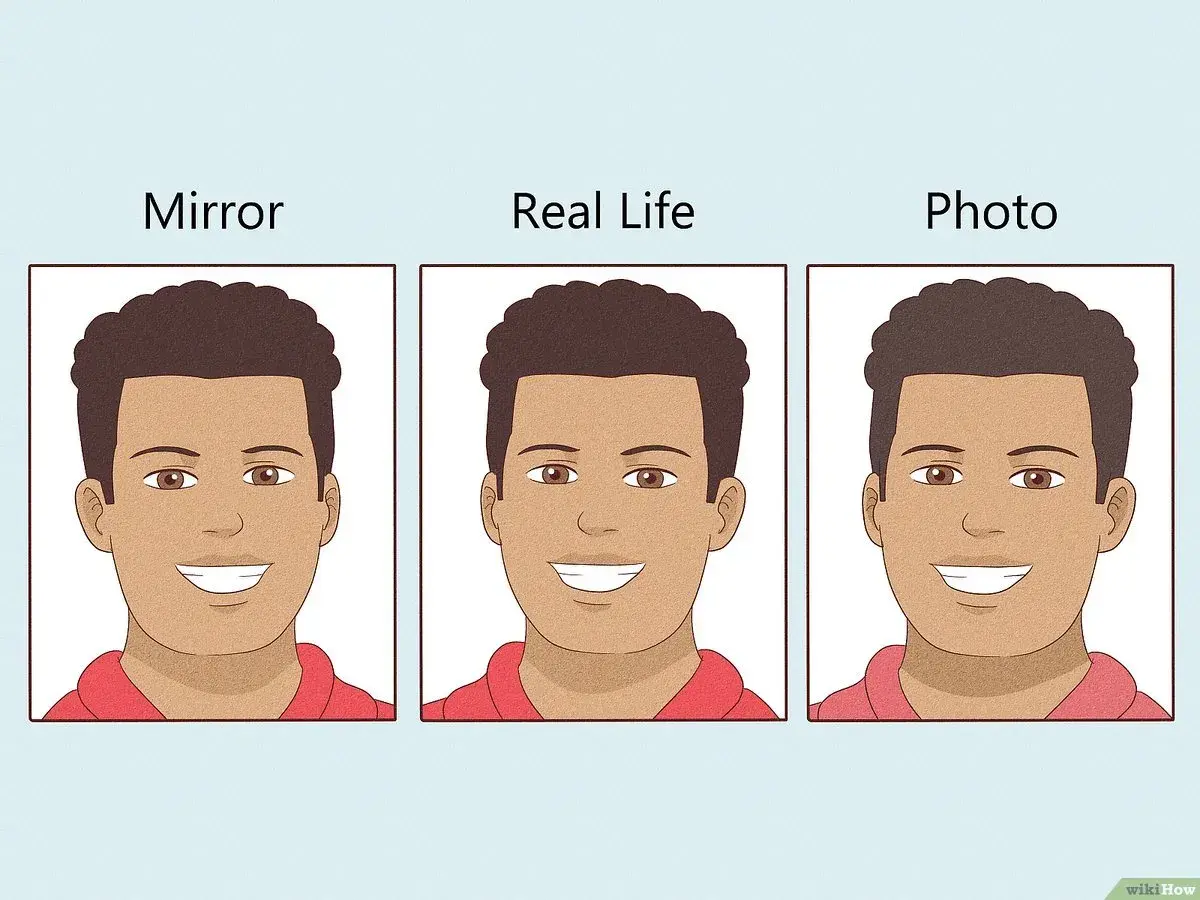
The reflection changes more than the mirror changes your size
- A flat bathroom mirror does not magnify you. It reflects you at true size.
- Curved mirrors can distort proportions, and concave mirrors can enlarge close-up features.
- Standing closer makes the reflection fill more of your field of view, which can feel like a bigger image.
- Overhead lighting and uneven side light can exaggerate shadows and body contours.
- A mirror that is flexing, poorly mounted, or damaged can warp the edges of the image.
- A larger mirror can make the bathroom feel bigger even when your reflection is unchanged.
What matters most is separating optical size from perceived size. Once you make that distinction, the answer becomes much simpler and much more useful in a real bathroom.
What a flat bathroom mirror actually shows
A standard wall mirror does not make your body physically bigger in the reflection. In a normal flat mirror, the image is the same size as the object, which is why a mirror only needs to be about half your height for you to see your full body. That simple rule is one of the clearest signs that the glass is not enlarging you.
What can change is the way your brain reads the image. If you stand close to the mirror, your face occupies more of your visual field, so it can feel larger even though the reflection itself is not magnified. I think this is where a lot of confusion starts: people notice a stronger visual presence and assume the mirror is stretching them when it is really just bringing the image closer to their eyes.
That matters because the next question is not just “is the mirror flat?” It is “what kind of mirror am I actually looking at?”
Which mirror types can really change proportions
Most bathroom wall mirrors in the United States are flat, but not all mirrors behave the same way. A few types can genuinely alter the apparent size of a face or body, and knowing the difference helps you avoid the wrong conclusion.
| Mirror type | Visual effect | What it means in a bathroom |
|---|---|---|
| Flat or plane mirror | True-size reflection with no optical magnification | The standard choice for vanity mirrors and medicine cabinets |
| Convex mirror | Makes the image look smaller and wider | Common in security settings, not ideal if you want an accurate look |
| Concave mirror | Can enlarge close-up features at certain distances | Used in magnifying makeup or shaving mirrors, not full bathroom wall mirrors |
| Flexible or poorly mounted mirror | Can warp edges and stretch lines | Can make the face, waist, or shoulders look subtly off |
That brings us to the part most people overlook: lighting and distance often do more than the mirror shape itself.
Why lighting and distance matter more than most people think
Two bathrooms can have the same mirror and produce completely different impressions. The biggest reason is lighting. Front-facing light tends to flatten shadows and give a more neutral reading of your face, while overhead light can deepen under-eye shadows, sharpen the jawline, and make features look more dramatic. Side lighting can be even trickier because it emphasizes one side of the face and can create the feeling that something is larger or heavier than it really is.
Distance is just as important. The closer you stand, the more the reflection fills your field of view, so the image can feel larger and more immediate. That does not mean the mirror has magnified you; it means the viewing conditions have changed. In a small powder room, that effect is stronger because the mirror, the sink, and your body are all packed into a tighter visual frame.
When I evaluate a mirror that seems “off,” I look at the lighting first. If the only place the reflection feels bigger or less flattering is a dim bathroom with a single ceiling fixture, the mirror is often innocent. The room is the real culprit, which leads directly to placement and scale.
How placement and scale change the way the room feels
A larger mirror can make a bathroom feel bigger without making you look bigger. Those are related but separate effects. A wide mirror expands the sense of space because it reflects more of the room, the wall finish, and the light. Your body still stays true-size in the reflection, but the room around it feels more open.
Placement matters too. A mirror centered over the vanity and aligned with normal eye level usually gives the most natural reading. If it sits too high, you end up tilting your chin up and judging yourself from an awkward angle. If it sits too low, your reflection can feel cropped and compressed, even though the glass itself is not distorting anything.
Here is the practical rule I use:
- Choose a mirror that fits the vanity width instead of overpowering it.
- Keep the mirror centered so the eye line lands naturally in the middle of the glass.
- Avoid mirrors that bow, rattle, or flex when touched.
- Use the mirror to reflect light and space, not to force a dramatic shape effect.
Once placement feels right, the last step is deciding what kind of mirror you actually want for daily use.
How I would choose a bathroom mirror for an accurate look
If your goal is an honest reflection, I would start with flat glass, rigid mounting, and even lighting. That combination removes most of the confusion people associate with bathroom mirrors. It is simple, but it works because it keeps the mirror from becoming a source of visual noise.
Here is the checklist I recommend:
- Pick a flat mirror for the main vanity view.
- Use a separate magnifying mirror only for close grooming tasks.
- Check the reflection from straight on and from a slight angle.
- Look for waviness near the edges, which often signals flexing or poor support.
- Pair the mirror with front or layered lighting instead of relying on a single harsh overhead bulb.
- If you want the room to feel larger, go wider with the mirror rather than curving the glass.
I also like to remind homeowners that a mirror is a fixture, not just décor. The installation quality matters as much as the glass itself. A well-mounted mirror on a flat wall with balanced lighting will usually give a much more trustworthy image than a fancier piece that flexes or reflects the room unevenly.
What I would recommend in a typical U.S. bathroom
For most bathrooms, I would not chase a mirror that makes you look bigger. I would choose one that gives a clean, stable reflection and then use lighting and placement to control how flattering the result feels. If you want the bathroom to appear larger, use a wider flat mirror or a frameless design. If you want more detail for grooming, add a small magnifying mirror separately.
That split is the cleanest way to think about it: one mirror for proportion, another for detail. If your reflection still seems off after that, the problem is usually the light, the mounting, or the wall behind the glass, not your face. In other words, the smartest fix is rarely a more dramatic mirror; it is a better one.