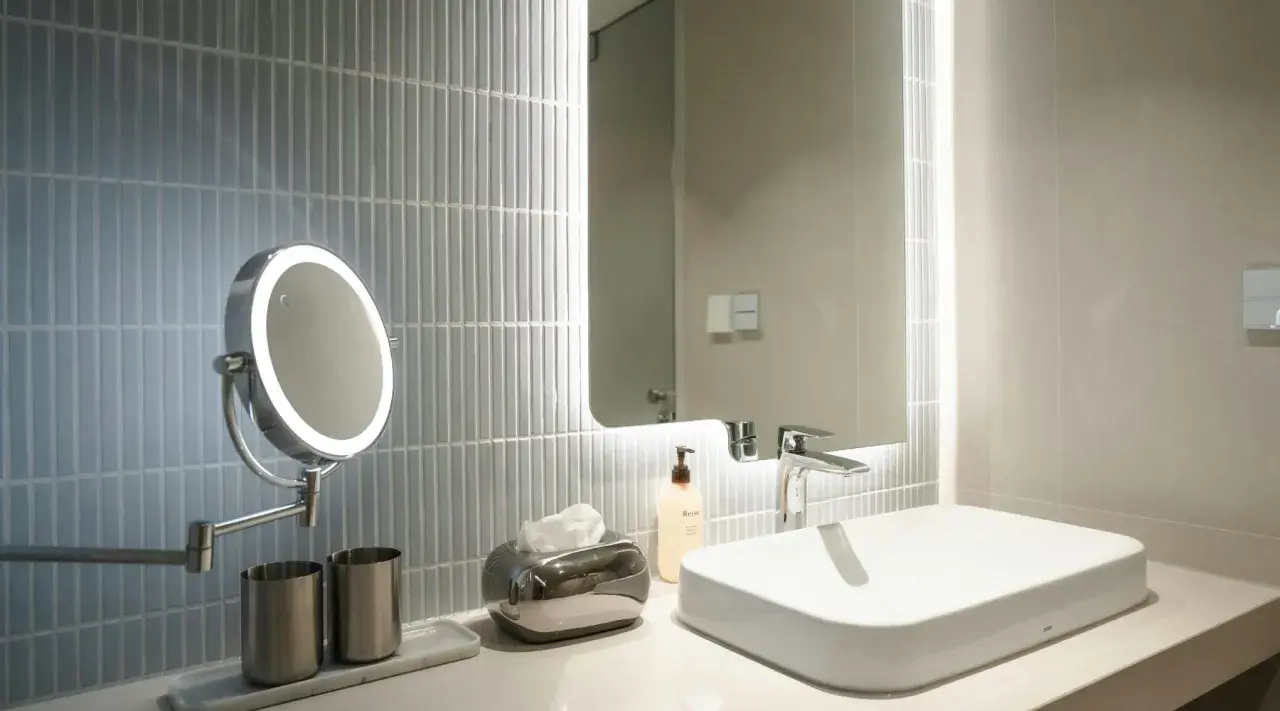
The lighting formula that keeps the mirror honest
- Face-level light beats overhead-only light because it reduces nose, chin, and under-eye shadows.
- Look for CRI 90+ so foundation, blush, and concealer read correctly in the mirror.
- 3000K to 3500K is the sweet spot for most bathrooms; tunable white is best if the room serves multiple moods.
- A typical vanity usually needs about 1,500 to 3,000 lumens total, then a dimmer to fine-tune it.
- Side sconces or a wide, diffused light bar usually work better than a bare ceiling fixture.
What good makeup lighting actually has to do
When I judge bathroom lighting for makeup, I start with the face, not the ceiling. The job of the light is to show skin in a way that is even, readable, and forgiving without hiding detail. That is why task lighting matters here: it is the light aimed at the work itself, not just the room.
The four things I want every vanity setup to do are simple. It should light both sides of the face evenly, show color accurately, avoid harsh glare in the mirror, and stay comfortable when the space shifts from early-morning grooming to late-night handwashing. Natural daylight is still the reference point, but a bathroom has to perform when daylight is weak, absent, or coming from the wrong angle.
- Evenness keeps makeup from looking patchy.
- Color accuracy keeps foundation, bronzer, and lipstick from drifting.
- Low glare makes the mirror usable instead of blinding.
- Control lets the same room work for makeup, shaving, and ambient use.
Once those four boxes are checked, the fixture style becomes much easier to judge, which is why I move from function to layout next.
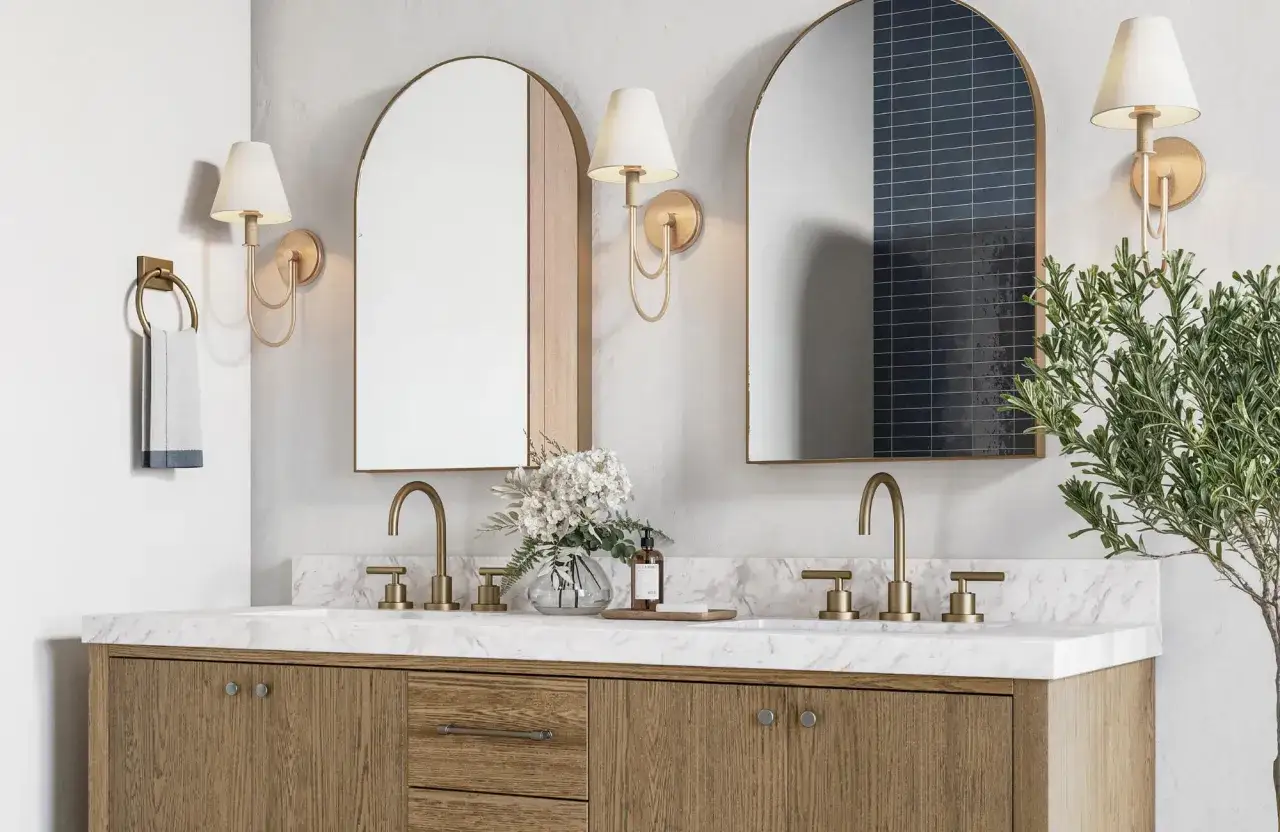
The fixture layouts I would choose first
I usually rank the options by how well they illuminate a face, not by how dramatic they look on a mood board. A fixture can be beautiful and still fail at makeup if it puts the brightest light above your forehead instead of around your features.
| Fixture layout | Why it works | Tradeoff | Best use case |
|---|---|---|---|
| Two side sconces | Balanced, cross-illumination on both sides of the face; best at reducing shadows | Needs wall space and proper wiring placement | Single vanities, shared baths, and any setup where makeup accuracy matters most |
| Wide linear light bar above the mirror | Clean look and broad coverage when the fixture is diffused | Can still throw shadows if it is too narrow or mounted too high | Compact bathrooms and remodels with limited wall area |
| Lighted mirror | Modern, space-saving, and often visually clean | Some models glow beautifully but do not push enough light forward | Small baths, minimal interiors, and rooms where wall fixtures would feel busy |
| Overhead-only lighting | Keeps the ceiling uncluttered and is easy to install | Casts under-eye and nose shadows; rarely ideal for makeup on its own | Only as a base layer, never as the only source for vanity work |
| Portable ring light or clip-on mirror light | Useful fallback when permanent changes are not possible | Not a true bathroom fixture and can feel temporary | Rentals, guest baths, travel setups, or a stopgap before remodeling |
If I had to pick one permanent solution, I would start with two side sconces or one long, diffused bar at face height. A backlit mirror can look elegant, but I treat it as part of the answer, not the whole answer, unless it throws enough forward light to behave like a true vanity fixture.
That leads directly to the question most people get wrong: not which fixture is prettier, but which spec sheet actually supports good color and shadow control.
The specs that matter more than the finish
Finish still matters for the room, but the spec sheet decides whether the mirror is actually useful. I look for CRI 90+ first, because color accuracy affects everything from concealer to lipstick; a 95 CRI fixture is even better if the rest of the design supports it.
Color temperature is the next decision. For most bathrooms, I like 3000K to 3500K because it stays warm enough to feel flattering without drifting so yellow that it hides redness or softens color too much. In 2026, tunable white LED fixtures are the most forgiving upgrade when the same bath has to work for makeup in the morning and calmer use at night.
| Spec | What I look for | Why it matters |
|---|---|---|
| CRI | 90+; 95 if available | Shows skin and makeup colors more faithfully |
| Color temperature | 3000K to 3500K, or tunable 2700K to 4000K | Keeps the light flattering without losing accuracy |
| Brightness | About 1,500 to 3,000 lumens total for a typical vanity | Enough task light without creating a harsh wall of brightness |
| Dimming | Yes, ideally on a quality wall dimmer | Lets one bathroom work for both task lighting and ambient use |
| Diffusion | Frosted glass, opal acrylic, or a built-in diffuser | Softens hotspots and mirror glare |
| Bathroom rating | Damp-rated at minimum near sinks; wet-rated where water can hit directly | Improves safety and fixture longevity in humid spaces |
I would not obsess over one number if the fixture is well diffused and dimmable. What matters is the combination: enough output, accurate color, and a quality shade or lens that spreads the light evenly instead of turning the mirror into a glare trap.
Once the spec sheet is right, placement is what turns a good fixture into a useful one.
How to place lights around a single or double vanity
This is where many otherwise good bathrooms fall apart. The right fixture can still look wrong if it is mounted too high, too far from the mirror, or sized without regard to the vanity underneath it. I like to set placement by face height first and aesthetics second.
- Put side sconces at eye level, usually around 60 to 70 inches from the floor in an average bathroom.
- If the lights flank the mirror, keep them roughly 36 to 40 inches apart on common vanity widths, then adjust for the mirror size.
- For an above-mirror light, start with a fixture that is about 4 inches narrower than the vanity or roughly 75 percent of the mirror width.
- Keep the light centered to the mirror and the sink, not just to the wall space.
- On a double vanity, either give each sink its own lighting zone or use one long, well-diffused fixture that spans both faces evenly.
For a single vanity, two sconces usually feel the most forgiving because they light the face from both sides. For a double vanity, a long bar can work, but only if it is wide enough and diffused enough to avoid making one person look brighter than the other. If the mirror runs very wide, I often prefer mirrored pairs of sconces so each sink gets its own illumination instead of sharing a compromise.
The rule I keep coming back to is straightforward: light the face where it actually sits. That sounds obvious, but it is exactly what gets lost when a fixture is chosen for style first and task performance second.
The mistakes that usually throw makeup off
I see the same mistakes again and again, and most of them are easy to avoid once you know what to look for. The frustrating part is that these rooms often seem fine from across the room and fail the moment someone starts blending foundation or lining the eyes.
- Overhead-only light creates shadows under the eyes, nose, and chin.
- Mixed color temperatures make one side of the face look different from the other.
- Low-CRI LEDs flatten color and can make makeup look different outdoors than it did in the mirror.
- Clear bulbs or shiny shades increase glare instead of improving clarity.
- Lights mounted too high make the eyes recede into shadow and make contour harder to judge.
- No daylight check means the bathroom looks good at night but fails in the morning.
I also avoid relying on backlighting alone for makeup. It looks polished, but it often illuminates the wall more than the face. That is a great aesthetic effect; it is a weak task-lighting strategy.
All of this is why I treat bathroom lighting as a system. The fixture, the bulb, the mirror, and the room finish all affect how the face reads, so one weak link can undo the rest.
The setup I keep coming back to in real bathrooms
If I were specifying a remodel today, I would keep the formula simple: two damp-rated side sconces or one wide diffused bar, CRI 90+, a 3000K to 3500K range, and a dimmer that lets the room soften after the makeup routine is done. That combination is practical, visually calm, and much harder to outgrow than a highly stylized fixture that only looks good in one lighting condition.
- Primary bath: side sconces at face height, paired with a wide mirror and layered ambient lighting.
- Small bath: a lighted mirror can save space, but I would still want forward-facing illumination, not just a halo effect.
- Shared bath: separate lighting zones help each person see their own face without crowding the other side of the mirror.
- Future-proof choice: tunable white LEDs give the best flexibility if you expect the room to serve multiple routines.
If you want the shortest possible answer, this is it: choose a high-CRI, dimmable, diffused fixture that lights the face from the front or both sides, not from above alone. That is the version that keeps makeup honest, the bathroom comfortable, and the design flexible enough to live with long after the remodel is finished.