Marble floors reward careful maintenance and punish shortcuts. The basics of cleaning marble floors are simple: remove grit before it scratches, use a neutral cleaner, dry the surface fast, and treat stains before they settle into the stone. In bathrooms and other wet areas, that routine matters even more because soap residue, hard water, and standing moisture can dull marble faster than most people expect.
What matters most when caring for marble floors
- Use a pH-neutral stone cleaner or a tiny amount of mild dish soap, then rinse and dry the floor.
- Skip vinegar, lemon, bleach, ammonia, abrasive powders, and steam mops.
- Dust-mop daily in busy areas so grit does not act like sandpaper.
- Etching is surface damage, not dirt, so dull spots usually need honing or polishing rather than more cleaner.
- Seal the stone when water stops beading, but do not treat sealer as stain-proof armor.
Why marble floors dislike ordinary cleaners
Marble is a calcium carbonate stone, which is the reason it looks elegant and also the reason it needs restraint. Acidic cleaners do not just “clean” marble badly; they chemically react with the surface and leave an etched, dull patch that no amount of scrubbing will reverse. That is why a bathroom cleaner that works on tile can be a poor choice on marble.I also think people underestimate the damage from grit. Tiny particles from shoes, dust, sand, and dried soap residue behave like fine sandpaper under a mop. On polished marble, that wear shows up quickly as haze or micro-scratches; on honed marble, it may take longer to notice, but the stone still needs the same gentle approach. Once you understand that distinction, the right routine becomes much easier to follow.
That brings us to the part that matters most in daily life: what a safe routine actually looks like when the floor needs to be cleaned, not babied.
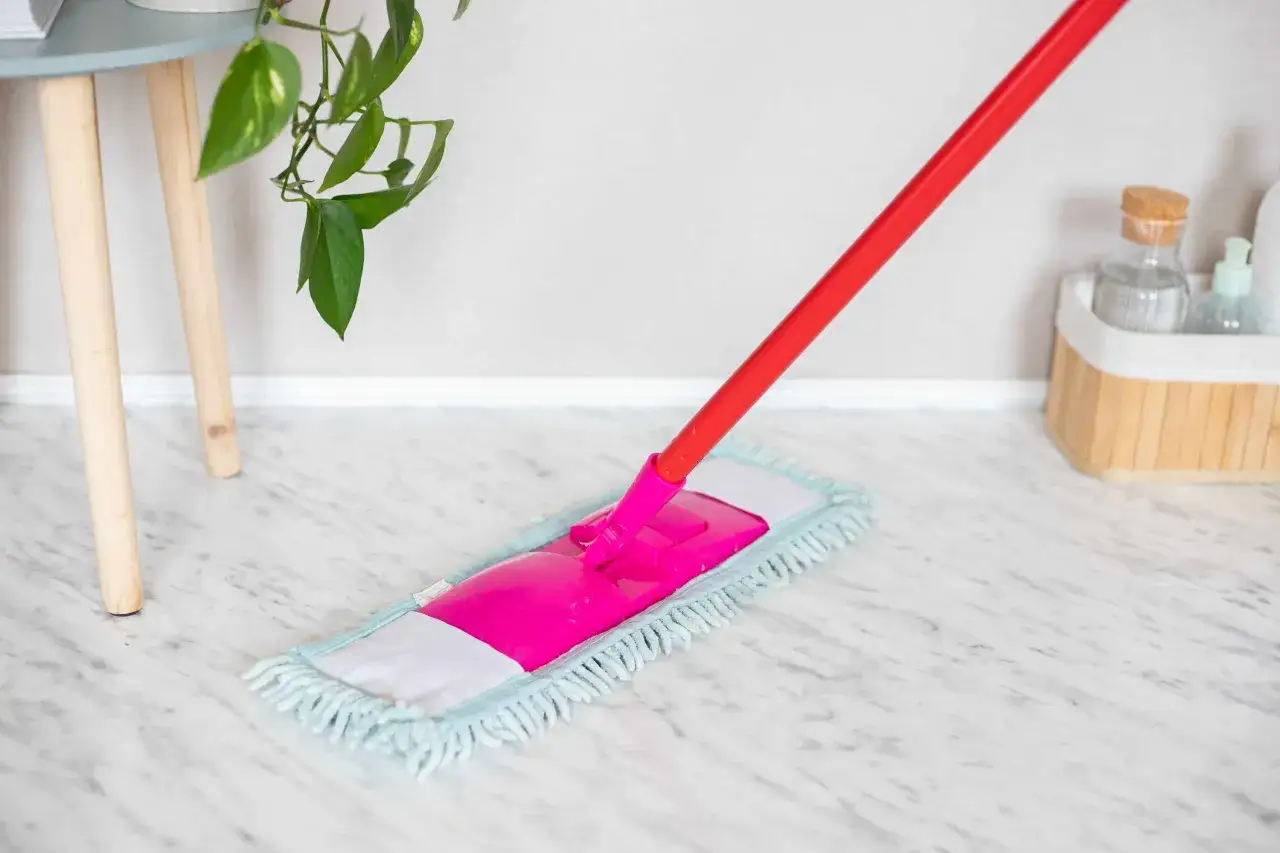
The safest daily routine for a marble floor
For routine care, I keep the process boring on purpose. Boring is good here. The goal is to lift dirt without flooding the stone or leaving behind residue that creates streaks later.
- Dust-mop or vacuum with a soft brush attachment first. This removes grit before water turns it into a scratchy slurry.
- Mix a pH-neutral stone cleaner with warm water, or use a very small amount of mild liquid dish soap if the manufacturer allows it.
- Wring the microfiber mop out well so it is damp, not wet. Marble does not like to sit under standing water.
- Work in small sections and rinse the mop often so you are not spreading gray film around.
- Follow with a clean water pass if the cleaner calls for it, then dry the floor with a microfiber towel or dry mop head.
The Natural Stone Institute recommends a neutral cleaner, stone soap, or a mild liquid dishwashing detergent with warm water, and I follow that rule because it keeps the stone clean without leaving the surface under chemical stress. In hard-water areas, I prefer distilled or filtered water for the final rinse because it reduces spotting.
In bathrooms, I am especially strict about drying around showers, tubs, and vanity splash zones. That little bit of extra effort is often what keeps the floor looking crisp instead of cloudy. Once the routine is set, the next question is usually which products deserve a place in the cabinet and which ones should stay away from marble entirely.
The products I trust and the ones I skip
Not every “gentle” cleaner is actually gentle on stone. I look first for a label that clearly says pH-neutral, stone-safe, or non-acidic. If a product is marketed for soap scum, lime scale, or bathroom disinfecting, I assume it is too aggressive unless it specifically says it is safe for marble.
| Product or method | Best use | Why it helps or hurts |
|---|---|---|
| pH-neutral stone cleaner | Daily or weekly cleaning | Cleans soil without attacking the stone or leaving a harsh residue. |
| Mild dish soap and warm water | Light grime when used sparingly | Works in a pinch, but too much soap can leave a film, so rinsing matters. |
| Stone soap | Routine maintenance on natural stone | Designed for marble and other delicate stone surfaces. |
| Vinegar, lemon, or acidic bathroom sprays | Do not use | Acid etches marble and can leave permanent dull marks. |
| Bleach or ammonia-heavy cleaners | Usually avoid | Can be too harsh for marble finishes and may damage sealers over time. |
| Abrasive powders, rough pads, steel wool | Do not use | They scratch the finish and make the floor look worn even when it is clean. |
| Steam mops | I skip them | Heat and excess moisture can stress marble and grout more than people expect. |
That table covers the obvious choices, but marble problems are not all the same. A spill, a stain, and an etched mark each need a slightly different response, and treating them the same is how many floors get damaged in the first place.
How to handle spills, stains, and dull spots
The fastest win on marble is immediate spill control. Blot, do not rub. Rubbing spreads the liquid and can grind debris into the finish. If the spill is acidic, such as citrus juice, vinegar, wine, or a strong bathroom cleaner, I wipe it up at once and then rinse the area with clean water. The difference between a small cleanup and a permanent mark is often measured in minutes.| Problem | What it usually is | First move | When to call a pro |
|---|---|---|---|
| Dull, whitish patch | Etching from acid | Stop cleaning aggressively and dry the area | If the mark remains after gentle cleaning, it likely needs honing or polishing |
| Dark oil spot | Cosmetics, lotion, cooking oil, or greasy residue | Blot excess, clean with a stone-safe product, then use a poultice if needed | If the stain is old, large, or keeps returning |
| Rust-colored mark | Metal contact or water around fixtures | Dry the area and avoid acidic rust removers | Often worth professional treatment because the wrong product can worsen the damage |
| Yellow or brown organic stain | Coffee, tea, food, or plant matter | Clean gently and avoid scrubbing harder | If it has had time to soak into the pores |
| Cloudy film | Soap buildup or cleaner residue | Rinse with clean water and dry thoroughly | If repeated rinsing does not remove the haze |
A poultice is just a paste that draws a stain out of porous stone over time. It can work well on oil-based stains, but it is not a cure-all, and it should be matched to the stain type. If the floor looks dull rather than dirty, the issue may not be a stain at all. It may be damage to the stone itself, which leads straight into maintenance and sealing.
Sealing and the habits that prevent damage
Sealer helps marble resist stains, but it does not make the floor waterproof, scratch-proof, or stain-proof. That distinction matters. A good penetrating sealer soaks into the stone’s pores instead of sitting on top like a coating, which is why I prefer it for marble flooring in bathrooms, kitchens, and other busy spaces.For sealed marble, I check water behavior at least once a year in low-traffic rooms and more often in wet zones. If water darkens the stone quickly or stops beading, it is time to look at resealing. In busy bathrooms and kitchens, a practical reseal window is often somewhere around 6 to 12 months; in lighter-use spaces, it may stretch to 1 to 3 years. The exact timing depends on traffic, cleaner use, and the specific stone.
Small habits matter just as much as sealers. I like to keep entry mats at the door, use bath mats that dry quickly, and avoid leaving damp rugs on marble for days. I also treat grout as part of the floor, not an afterthought, because grout is usually more porous than the stone and can trap soil that makes the whole surface look tired. Once those habits are in place, the last question is when cleaning is no longer enough.
When cleaning is no longer enough
If the floor still looks hazy after a proper neutral-cleaner wash and dry, I start thinking about etching, wear, or finish loss instead of dirt. That is the point where more cleaner usually makes the problem worse, because the surface is already damaged. Polished marble shows this most clearly as a dull, uneven reflection; honed marble can look flatter or blotchy instead of shiny.
Restoration usually means honing or polishing with diamond pads and stone-specific equipment. Honing smooths the surface to remove light damage and gives a satin or matte look; polishing refines the finish again if the goal is a higher sheen. On large floors, especially in bathrooms where the sheen needs to look even from tile to tile, I would rather bring in a stone professional than experiment with a rented buffer and the wrong pad.
That is the practical line I use: clean when the problem is soil, restore when the problem is the stone itself. From there, the floor only needs a simple rhythm to stay presentable for years.
The care rhythm I use for busy homes
For most homes, the routine does not need to be complicated. It needs to be consistent.
- Daily in busy areas: remove grit and spot-dry spills.
- Weekly: damp mop with a neutral cleaner and dry the floor completely.
- Monthly: check for film, dulling, loose grout, or water spots near sinks and showers.
- Every 6 to 12 months in wet, high-traffic spaces: test whether the sealer is still doing its job.
- As needed: stop etching early, because marble damage gets more expensive the longer it sits.
If I had to narrow the whole process down to one rule, it would be this: keep the surface clean, keep it dry, and keep acids away from it. That is enough to protect most marble floors in everyday U.S. homes, and it is far more effective than chasing miracle cleaners after the stone has already been dulled.