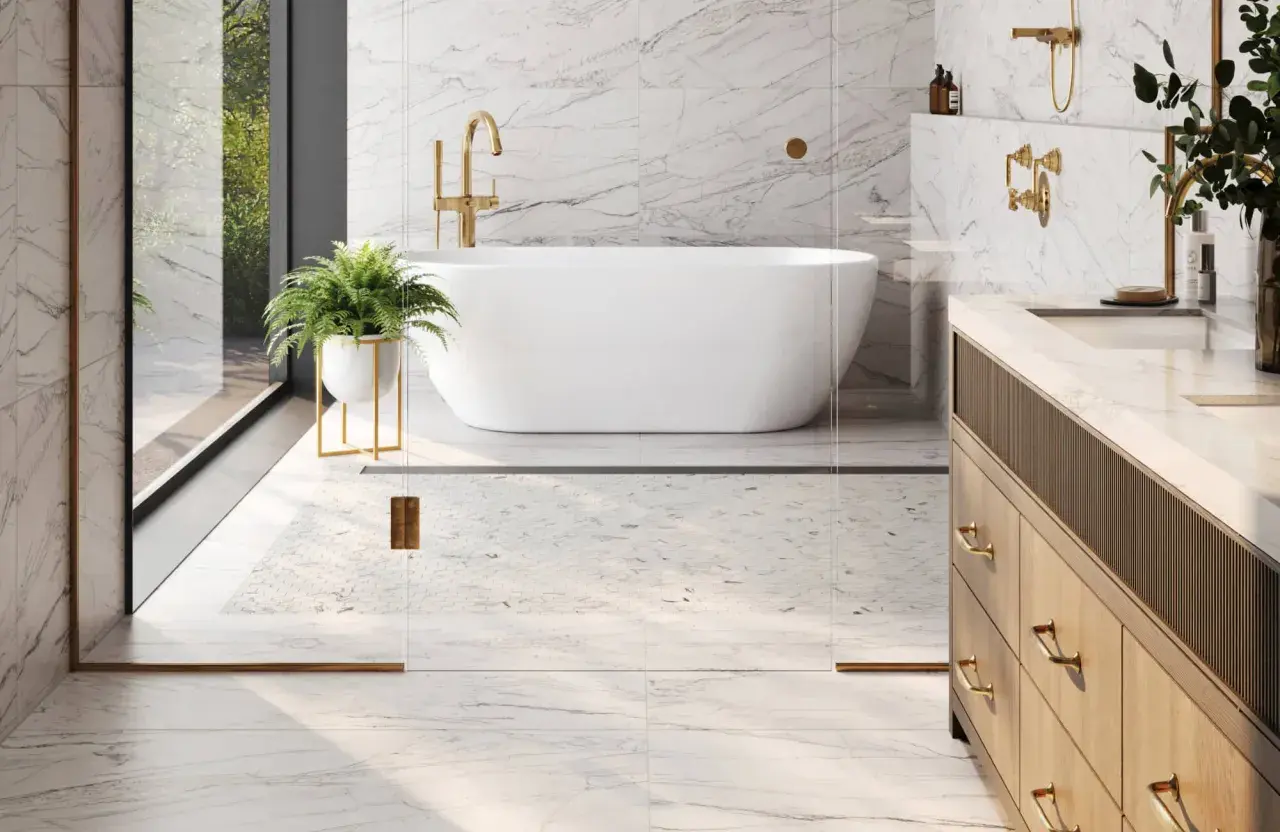
Marble works in bathrooms only when you design around its weaknesses
- Best use case: a primary bath or guest bath where style matters and the floor will not see constant abuse.
- Best finish: honed marble, because it is less slick and hides wear better than polished stone.
- Main risk: acids, moisture, and gritty debris can leave etches, stains, and scratches on the surface.
- Maintenance reality: sealing helps, but it does not make marble stain proof.
- Safer low-maintenance option: marble-look porcelain if you want the appearance without the upkeep.
Why marble still earns a place in bathroom design
Marble has one advantage that is hard to fake: it gives a bathroom depth. The veining is natural, the movement feels organic, and even a small floor can look more intentional when marble is used well. I still like it in bathrooms because it makes the room feel finished rather than simply furnished.
It also pairs nicely with radiant heat, which matters because stone can feel cold underfoot. If you are remodeling a primary bath and you want the floor to feel quiet, polished, and a little more architectural than standard tile, marble can absolutely deliver that effect. I would just be honest about the tradeoff: the beauty is real, but so is the upkeep.
That tradeoff becomes more obvious once you look at how marble behaves in wet, messy, everyday use.
Where marble causes problems underfoot
Marble is a calcareous stone, which means it reacts badly to acids. Toothpaste, vinegar-based cleaners, some bath products, and even a careless splash of an acidic cleaner can dull the surface or leave an etch mark. The Natural Stone Institute notes that sealing makes stone more stain resistant, not stain proof, and that acids can dull or etch calcareous stone. That is the right mindset to bring into a bathroom: sealing helps, but it does not make marble carefree.
Moisture is the other issue. A bathroom floor sees water tracked from showers, sinks, and damp towels, so standing moisture and residue are normal. On marble, that can mean water spots, rings, soap film, and more visible wear in traffic paths. If the surface is polished, it may also feel slipperier when wet, which is why I am cautious about using polished marble on a floor that gets daily splash exposure.
Then there is grit. Sand, dirt, and even tiny debris brought in on shoes or bath mats can act like fine sandpaper. Over time, that is what dulls the finish and creates the worn-in look people often mistake for “character.” In reality, it is just wear. Once you understand those weak points, the next step is choosing a finish that gives marble a better chance.
Which finish and tile format make marble work better
If I were specifying marble for a bathroom floor, I would start with finish before color. Finish changes how the floor feels, how it handles moisture, and how forgiving it is when real life happens.
| Option | What it changes | My take for bathroom floors |
|---|---|---|
| Honed marble | Matte or satin surface with a softer look | The best all-around choice for most bathrooms because it is less slippery and hides etching better. |
| Polished marble | Glossy, reflective surface that shows veining more dramatically | Beautiful, but best reserved for low-use bathrooms, walls, or powder rooms rather than wet floors. |
| Small-format tile or mosaic | More grout lines and more surface interruption | Useful where traction matters, especially near showers, because the added grout can help with grip. |
| Large-format tile | Cleaner, more seamless look with fewer grout joints | Elegant, but every mark is more visible, and the floor depends even more on finish and maintenance. |
My preference is honed marble in a format that gives the floor a little more visual texture. It is not indestructible, but it gives you a better balance of traction, appearance, and forgiveness than a high-gloss surface. Polished marble has its place, yet I would use it selectively and never pretend it is the easiest answer for a busy family bath.
Once you have the finish right, the floor becomes much more manageable. The routine that follows matters just as much as the material itself.
How to care for a marble bathroom floor without overcomplicating it
Marble is not difficult because it needs constant special treatment; it is difficult because the wrong habits create damage quietly. Keep the routine simple and consistent, and the floor will usually stay attractive much longer.
- Use a penetrating sealer on the schedule your stone supplier recommends, and remember that it is a repellent, not a shield.
- Clean with a pH-neutral stone cleaner or mild soap and water.
- Avoid vinegar, lemon, bleach, and abrasive powders, which can dull or etch the surface.
- Wipe up water and product spills quickly, especially toothpaste, mouthwash, cosmetics, and bath oils.
- Use mats with a slip-resistant backing near the tub, shower, and vanity.
- Remove grit often with a soft dust mop or a vacuum attachment that will not scratch the stone.
If you do see an etch mark, do not assume it is a stain that can be cleaned away. Etching is a surface change, not just residue, so it may need professional refinishing if it is noticeable. I also tell homeowners to treat marble floors as “dry as possible” surfaces: they can handle bathroom life, but they do not like being left wet and dirty.
That leads naturally to the comparison most people should make before buying marble at all: not what looks best on a sample board, but what will be easiest to live with for years.
Marble vs porcelain when you want the same look with less upkeep
When someone wants the marble look but does not want to think about sealing, spot-cleaning, or etching, marble-look porcelain is usually the smart comparison. It does not have the same natural depth, but it is easier to maintain and far more forgiving in a wet room.
| Material | Look | Upkeep | Best fit |
|---|---|---|---|
| Marble | Authentic veining and natural variation | Higher maintenance, needs sealing and careful cleaning | Design-led bathrooms where the owner accepts active care |
| Marble-look porcelain | Very convincing from a distance, especially in larger formats | Easy to clean and far less sensitive to water and acids | Busy family bathrooms, guest baths, and low-maintenance remodels |
If the bathroom is used hard, porcelain usually wins on practicality. If the room is meant to feel luxurious and the owner is realistic about upkeep, marble still has a place. I would not frame it as a better-or-worse decision so much as a lifestyle decision.
The most common mistake I see is choosing marble for the look and then hoping it will behave like a maintenance-free surface. That is where disappointment starts.
What I would specify before putting marble underfoot
If I were designing a bathroom floor for a real home, I would choose marble only when the room has enough ventilation, the finish is honed, and the homeowner is comfortable doing basic stone care. I would also be more comfortable using marble in a primary bath with a defined dry zone than in a chaotic kids’ bathroom where water and product spills happen all day.
- Choose honed marble instead of polished for most floors.
- Keep the layout simple so the stone feels intentional, not busy.
- Use pH-neutral cleaners only.
- Plan for fast drying after showers or sink use.
- Keep spare tiles from the same lot for future repairs.
That is the balance I would use in a real remodel: marble is a design decision first and a maintenance decision second. If you accept both sides of it, the material can be excellent on a bathroom floor; if you want a floor you never have to think about, porcelain is the more practical choice.