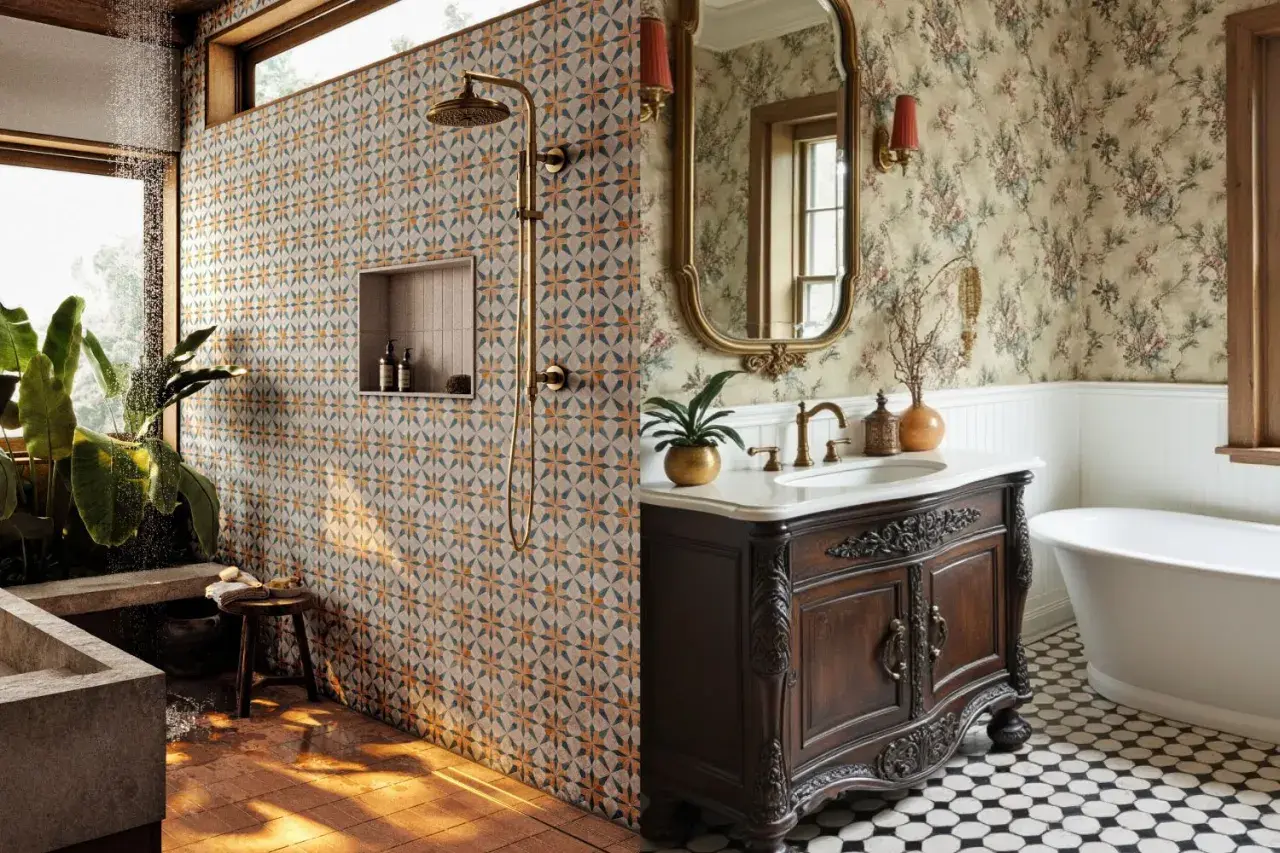
Choosing timeless bathroom flooring is less about finding a single "perfect" material and more about balancing water resistance, traction, cleaning effort, and the way the room will age. The floors that last look calm today, still make sense years from now, and do not create a maintenance burden you start resenting. In practice, that usually means favoring simple shapes, honest materials, and finishes that behave well in a wet room.
The floor should stay calm, safe, and easy to live with
- Porcelain tile is the safest all-around choice for most U.S. bathrooms because it handles water well and comes in endless looks.
- Natural stone gives the richest character, but it only stays elegant if you accept sealing and gentler cleaning.
- Matte or honed finishes usually age better than glossy ones in wet spaces.
- Simple patterns, quiet grout colors, and balanced tile scale matter as much as the material itself.
- Installation prep, waterproofing, and slip resistance can change the real outcome more than the tile label.
What makes a bathroom floor feel timeless
When I judge whether a bathroom floor will still feel right in five or ten years, I look at four things first: moisture handling, slip resistance, visual simplicity, and upkeep. If a floor fails on any one of those, the design gets old faster than people expect.
- Moisture handling matters because bathrooms are not dry rooms, even when they are well ventilated.
- Slip resistance matters because a beautiful floor is a bad trade if it feels slick after a shower.
- Visual simplicity helps a floor survive style changes in vanities, paint, and hardware.
- Upkeep is the quiet deal-breaker, because a high-maintenance floor can stop looking fresh long before it wears out.
That is why I tend to trust neutral tones, restrained veining, and finishes that diffuse light instead of bouncing it around. Once those filters are in place, the shortlist gets much smaller and easier to compare.
The materials I would shortlist first
Here is the mix I would actually shortlist for a bathroom floor in the United States, because it covers the right balance of longevity, cost, and maintenance.
| Material | Why it lasts | Tradeoffs | Typical installed cost | My take |
|---|---|---|---|---|
| Porcelain tile | Very low water absorption, broad style range, and easy coordination with stone, wood, or concrete looks | Hard underfoot, grout needs care, and it can feel cold without radiant heat | $9-$50 per sq ft | The most dependable all-around choice for longevity and resale |
| Ceramic tile | Classic, versatile, and usually easier on the budget than stone | Less dense than porcelain, so I prefer it for lighter-duty floors or secondary baths | $10-$25 per sq ft | Good when you want a classic look without pushing the budget |
| Natural stone | Real depth, subtle variation, and a finish that can look better as the room ages | Needs sealing, can etch or stain, and usually costs more to install properly | About $18-$32+ per sq ft for marble floors, often higher for premium stone and complex work | Best for homeowners who want character and are willing to maintain it |
| Luxury vinyl tile | Waterproof versions are practical, quieter, softer, and often budget-friendly | Less architectural presence, and it does not age with the same gravity as tile or stone | $3-$13 per sq ft | A sensible fallback when comfort, speed, or cost matters most |
Porcelain usually wins because it gives me the widest design range with the least drama. The material itself is the ceramic family member with water absorption at or below 0.5 percent, which is why it behaves so well in bathrooms. If the room needs extra warmth, I often look at wood-look porcelain before I look at real wood, because it gives the style without the moisture gamble.
Natural stone is the premium choice, but premium does not automatically mean practical. I would only choose it when the homeowner understands sealing, cleaning, and the fact that patina is part of the contract. That tradeoff is exactly why the pattern and finish matter so much next.
Patterns and finishes that stay calm over time
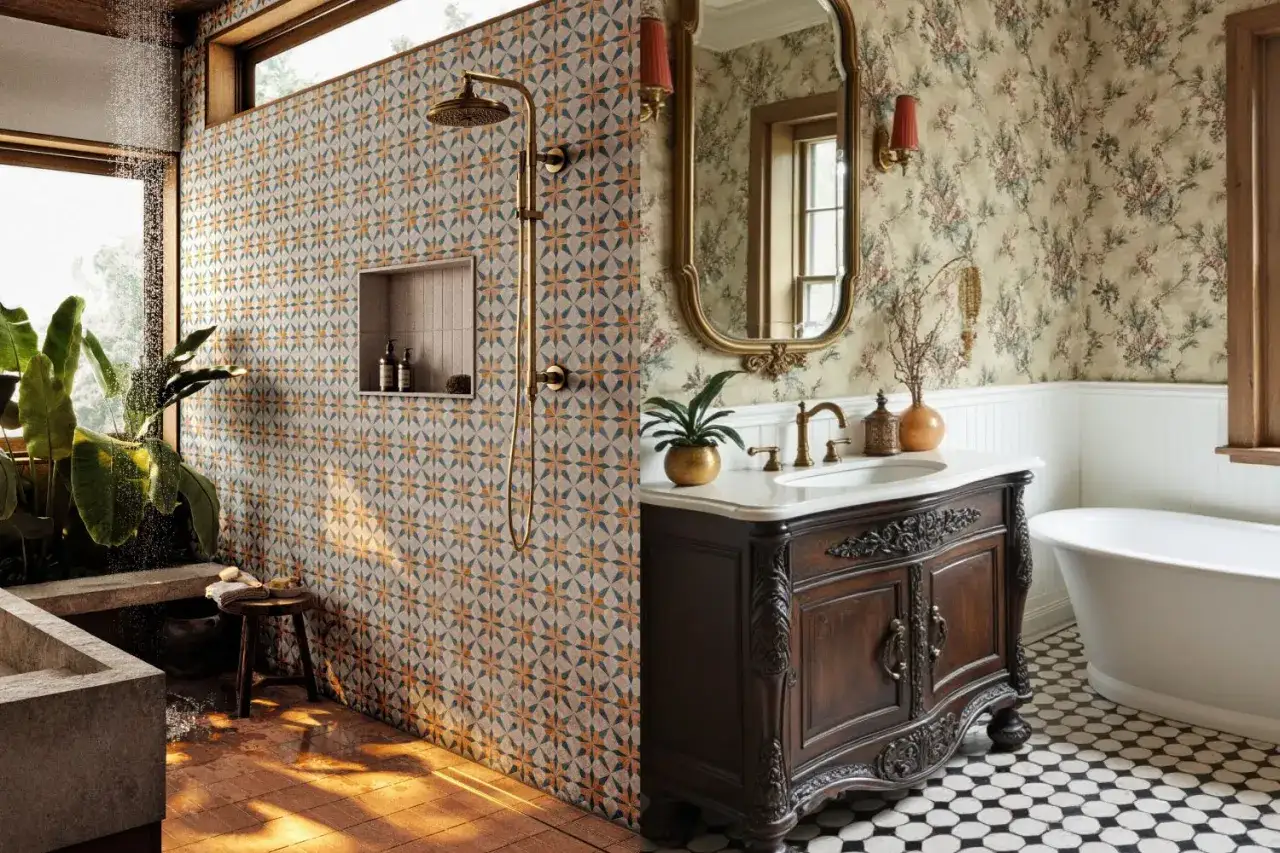
The strongest looks in 2026 still lean natural rather than loud. I like patterns that add structure without screaming for attention, because they still read well when the vanity, mirror, and fixtures change later.
- Large-format porcelain gives a quieter field with fewer grout lines, which makes the room feel cleaner and more open.
- Black-and-white checkerboard can be timeless when the contrast is controlled and the tile size fits the room instead of overpowering it.
- Herringbone adds movement without depending on a trendy color story, so it feels thoughtful rather than flashy.
- Hex or penny tile works best in powder rooms or shower floors, where the smaller format can add traction and texture.
- Honed or matte finishes usually age better than glossy surfaces because they hide water spotting and feel less slippery.
Rectified tile, which is machine-cut for tighter edges, can help a floor read cleaner because the grout lines stay slimmer. That does not automatically make it better, but it does make the room feel more deliberate.
I also pay attention to grout color. A grout line that is close to the tile color lets the floor read as one calm surface, while high-contrast grout turns every joint into a design decision. That can be great in a powder room, but it is less forgiving in a busy family bath.
If you want the floor to stay timeless rather than merely fashionable, keep the pattern simple, the finish soft, and the color story restrained. From there, the room layout tells you how bold you can afford to be.
How I match the floor to the room
Not every bathroom should be treated the same way. A powder room can carry more personality because it sees less water and less daily traffic, while a family bath usually needs a quieter, harder-working surface.
| Bathroom type | Better floor choices | Why it works |
|---|---|---|
| Powder room | Checkerboard, small hex, or another restrained statement pattern | Low moisture and small square footage let you be a little more expressive without risking long-term regret |
| Family bathroom | Matte porcelain, ceramic, or stone-look tile with a simple layout | Easier to clean, safer for wet feet, and less likely to feel busy once towels, rugs, and accessories are added |
| Primary bath | Porcelain with quiet veining, or natural stone if you want more depth | Supports a spa feel without forcing the room to chase a trend |
| Small bathroom | Larger-format tile or a calm small pattern with narrow grout lines | Fewer visual breaks help the room feel less chopped up, as long as the tile cuts around the perimeter still look intentional |
| Aging-in-place bath | Textured porcelain or another floor-rated tile with minimal transitions | Safety and ease of cleaning matter more than a decorative flourish here |
I often tell people that small bathrooms are not automatically supposed to have tiny tile. In a lot of cases, a larger format makes the room feel more settled, as long as the layout is planned well and the cuts at the edges do not look awkward. That leads straight into cost, because the wrong layout can change the budget as much as the material does.
What the budget looks like in the U.S.
In 2026, the sticker price of the tile is only part of the story. Demo, subfloor work, waterproofing, layout complexity, and labor often matter just as much, and bathrooms have a way of exposing every weak point in the floor below.
| Cost item | Typical 2026 range | Why it matters |
|---|---|---|
| Tile removal | $1-$7 per sq ft | Removing old flooring can add more cost than people expect before the new floor even starts |
| Basic tile installation | $5-$15 per sq ft | Useful as a rough baseline for straightforward jobs |
| Ceramic or porcelain labor | $4-$8 per sq ft | Higher cuts, smaller rooms, and extra prep push the number upward |
| Natural stone labor | $6-$15+ per sq ft | Stone usually needs more care, more sealing, and more specialized handling |
| Bathroom floor tile job overall | About $16.58-$20.60 per sq ft | A handy national reference point for a straightforward bathroom floor |
That is why a quote for porcelain can look modest at first and still end up expensive once the room needs leveling or waterproofing. On a 60-sq-ft bathroom floor, every extra $5 per sq ft adds roughly $300, which is enough to move a project from comfortable to annoying very quickly. If I am comparing two materials, I do not just ask what the tile costs; I ask what the fully installed floor will cost after all the hidden work is counted. That question usually separates the sensible choice from the pretty one.
Installation and maintenance details that protect the look
This is the part people skip, and it is where a lot of floors lose their elegance early. A timeless floor is not only about the surface you see, but about the decisions beneath it.
- Check the slip rating. For level interior wet areas, I want a wet DCOF, the wet slip-resistance rating for hard-surface tile, of at least 0.42 as a practical screen, not as the whole answer.
- Use the right finish. Matte or honed surfaces usually look calmer and feel safer than polished ones.
- Match tile size to the use. Smaller formats or mosaics make sense on shower floors because the extra grout lines help with traction.
- Remember shower floors are different. Pitch, tile size, and grout all matter together, so I do not rely on one slip number alone.
- Choose grout intentionally. Epoxy grout is worth a look if you want lower upkeep, because it resists staining better and does not need sealing in the same way cement grout does.
- Seal natural stone on schedule. In a busy bathroom, resealing is often needed every 6 to 12 months, though the exact timing depends on the stone and sealer.
- Protect the floor at cleaning time. Acidic cleaners and abrasive scrubs are rough on stone, and even good tile can look tired if residue builds up.
I also care about the underlayment and waterproofing layer, because tile is only as stable as what supports it. If the substrate moves or the waterproofing is sloppy, even a beautiful floor can crack, stain, or telegraph problems too early. Good installation is boring work, but it is what keeps the room looking calm.
Flooring I would skip or use only with caution
Some materials are not bad, they are just bad fits for a bathroom when longevity is the goal. I am much more cautious with anything that looks striking on day one but demands perfect conditions to stay that way.
- Polished glossy tile can look elegant, but it is more likely to feel slick and show water spotting.
- Wall-only tile used on the floor is a mistake I would avoid entirely, because floor performance requirements are different.
- Porous stone without a maintenance plan is a trap, because the floor only stays refined if you keep up with sealing and cleaning.
- Novelty patterns across the whole room tend to date faster than restrained ones, especially when the vanity or paint changes later.
- Real wood in a typical full bath is a high-maintenance bet unless the room is unusually dry and carefully detailed.
When someone wants warmth, I usually steer them toward wood-look porcelain rather than real wood. It scratches the same visual itch without asking the bathroom to behave like a bedroom. That compromise is often what makes a floor both practical and long-lived.
The simplest way to choose without second-guessing yourself
If I had to make the call quickly, I would start with a matte or honed floor-rated porcelain tile in a quiet stone or warm neutral tone, then decide whether the room truly needs more personality than that. If the answer is yes, I would add character through pattern or grout in a powder room, not by forcing the main bathroom floor to do too much.
- Choose porcelain if you want the broadest mix of durability, water resistance, and low drama.
- Choose natural stone if you want richer character and you are comfortable with sealing and gentler care.
- Choose ceramic if the bathroom is lighter-duty and you want a classic floor at a friendlier price.
- Choose luxury vinyl tile if budget, comfort, or quick installation matters more than having the most permanent-feeling surface.
The last test I use is simple: I put the samples on the floor, look at them in morning light and again at night, and judge whether they still feel calm when I imagine the vanity, walls, and fixtures changing around them. If a floor can survive that test, it usually survives the trend cycle too.
If you want one upgrade that improves the daily feel of a classic tile floor without changing its look, I would consider radiant heat, especially over a cold slab. After that, the last step is old-fashioned: put the samples on the floor, check them in morning and evening light, and make sure the tile, grout, and vanity all feel like they belong in the same room.