Choosing grout sounds minor until the wrong mix stains, cracks, or looks out of place next to the tile. The right choice depends on joint width, tile surface, moisture, cleaning habits, and how much performance you want from the installation. In this guide, I break down the practical grout options used in tile work, where each one belongs, and the tradeoffs that matter most in bathrooms, kitchens, and other high-use spaces.
The quick take on grout selection
- Most U.S. tile projects come down to cementitious grout, epoxy grout, or ready-to-use grout.
- Sanded grout fits wider joints, while unsanded grout suits tighter joints and more delicate tile surfaces.
- Epoxy gives the strongest stain and moisture resistance, but it is less forgiving to install and usually costs more.
- Ready-to-use grout saves mixing time, but the product label matters more than the packaging claims.
- Joint width and tile material should drive the choice before color does.
The main grout families you will actually choose from
In day-to-day residential work, I usually narrow grout down to four families: cementitious, epoxy, ready-to-use, and furan. That order reflects how most bathroom and kitchen projects are really decided, with the first three covering the overwhelming majority of tile installations.
| Grout family | Best fit | Why it stands out | Main limitation |
|---|---|---|---|
| Cementitious grout | Most standard floors, walls, backsplashes, and showers | Familiar, affordable, easy to find, and available in sanded or unsanded versions | More porous than epoxy and usually needs sealing or more maintenance |
| Epoxy grout | Showers, kitchens, commercial spaces, pools, and stain-prone areas | Very low absorption, strong chemical resistance, and no sealing in most cases | Harder cleanup, shorter working time, and higher material and labor cost |
| Ready-to-use grout | Many residential walls, backsplashes, and some floors | No mixing, consistent color, and faster prep on the job | Product limits vary, and some formulas are not meant for steam, hot tubs, or submerged use |
| Furan grout | Industrial and chemical-heavy environments | Specialty resistance for severe service conditions | Specialized installation, limited use, and not a normal bathroom choice |
Cementitious grout is the default for a reason. It is made from cement, pigments, fine aggregates, and often polymers that improve strength and workability. Epoxy is a different animal: it is resin-based, far less porous, and much better at resisting stains and chemicals. Ready-to-use grout sits between those two worlds in a practical sense, especially on projects where speed and color consistency matter more than raw industrial durability. Furan is worth knowing about, but I only see it in demanding commercial specs, not in a typical home renovation. If I am reading a product label in the U.S., I also pay attention to whether the ready-to-use formula aligns with ANSI A118.19, because that tells me I am looking at a recognized organic premixed category rather than a vague marketing claim.
Why sanded and unsanded grout are not interchangeable
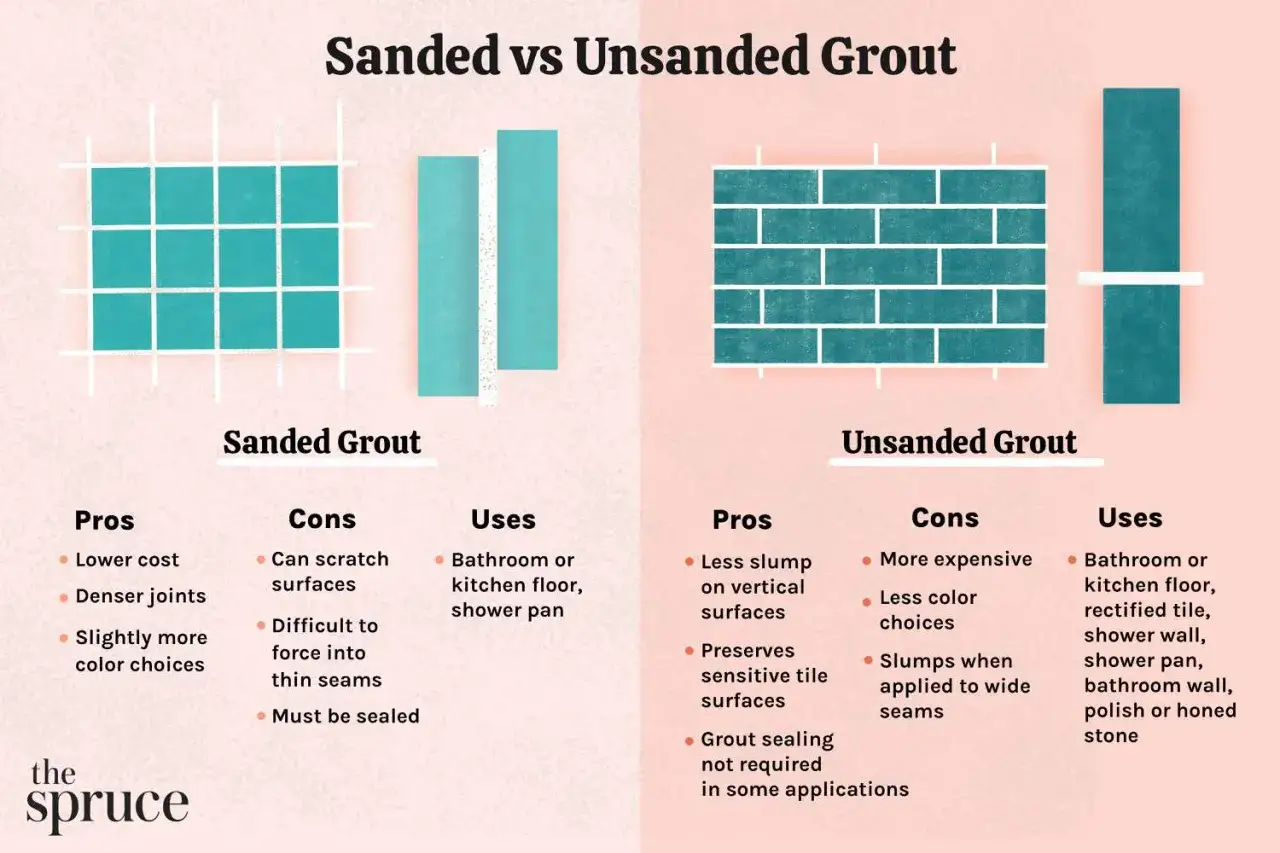
This split matters more than most people expect. Sanded grout contains aggregate, which helps it hold shape in wider joints and reduces shrinkage. Unsanded grout is smoother and easier on polished or soft surfaces. When I am choosing between them, I look at the joint first and the tile face second.
| Detail | Sanded grout | Unsanded grout |
|---|---|---|
| Typical joint range | Usually 1/8 inch to 1/2 inch | Up to 1/8 inch |
| Best for | Floors, wider joints, and more forgiving tile surfaces | Narrow joints, polished stone, glass, and delicate finishes |
| Main risk | Can scratch some ceramic, glass, marble, metal, or stone tiles | Can shrink or crack if forced into a joint that is too wide |
| Texture | More textured and robust | Smoother and finer |
Some manufacturers also sell coarse-aggregate blends for wider joints. I still treat those as part of the sanded family, not as a magic fix for every installation problem. The other number I keep in mind comes from the Tile Council of North America: a minimum 1/8-inch grout joint for rectified tile and a minimum 3/16-inch joint for calibrated tile. That guidance matters because tile edges are never as perfect in the real world as they look in a showroom, and the joint has to accommodate that reality.
If the tile is polished marble, glass mosaic, or a surface that marks easily, unsanded grout is usually the safer default. If the tile is on a floor, the joints are wider, or the installation needs more body and resistance to wear, sanded grout is usually the better fit. From there, exposure decides whether cementitious grout is enough or whether I would move up to epoxy or a ready-to-use formula.
Where each grout works best in a bathroom or kitchen
The room changes the answer. Water, soap residue, cooking grease, foot traffic, and cleaning chemistry all push grout selection in different directions. I rarely choose the same grout for a vanity backsplash, a shower floor, and a commercial kitchen wall.
| Area | My usual pick | Why it works there | What I would watch |
|---|---|---|---|
| Shower walls | Epoxy or a high-performance ready-to-use grout approved for wet use | Handles moisture and soap scum better than basic cement grout | Check the product limits if the space is steam-heavy |
| Shower floors | Epoxy first, then a durable cementitious grout if maintenance is acceptable | Standing water and frequent cleaning punish weaker grouts fast | Do not assume grout is waterproofing |
| Kitchen backsplash | Unsanded cementitious or ready-to-use grout | Narrow joints and easy wipe-downs usually matter more than brute strength | Grease can still stain porous grout if cleanup is delayed |
| Bathroom floor | Sanded cementitious or epoxy | Foot traffic favors a more durable joint | Match the grout to the tile texture so cleaning stays simple |
| Glass mosaic or polished stone | Unsanded grout, or a product specifically approved for sensitive surfaces | Reduces the risk of scratching or dulling the tile | Always test a sample first |
| Pool, spa, or fountain | Epoxy or a system-specific specialty product | Submerged service demands strong resistance to water and chemistry | Not every ready-to-use grout belongs here |
For showers, I care less about trendy color and more about how the grout will behave after hundreds of wet-and-dry cycles. For backsplashes, the balance shifts toward ease of use and appearance. For submerged or heavily sanitized environments, I want the product to be clearly approved for that job, not merely described as "premium."
How I choose grout by tile surface and joint width
When a client asks me what grout to use, I work through the selection in the same order every time. It keeps the decision practical instead of emotional, which is useful because grout color samples can be misleading once they are installed and cured.
- Measure the joint width, not just the tile size. Under 1/8 inch, unsanded or a product rated for narrow joints is usually the right lane. From 1/8 inch to 1/2 inch, sanded grout is common. Beyond that, I check the manufacturer data before I assume anything.
- Check the tile surface. Polished marble, glass, and some metal tiles can be scratched or dulled by sanded grout, so I lean unsanded unless the label says otherwise.
- Check the exposure. The wetter, dirtier, or more chemically aggressive the space is, the more I lean toward epoxy or a high-performance ready-to-use formula.
- Check the maintenance tolerance. If nobody wants to reseal or babysit the grout, cementitious grout starts to look less attractive.
I also separate grout from waterproofing in my head. Grout fills the joint; it does not replace a membrane, a proper backer system, or flexible sealant at changes of plane. Corners, transitions, and movement joints should be treated as movement joints, not packed full of grout and forgotten.
One practical detail people miss is that grout color and texture change the visual scale of the tile. A softer, closer-matching grout can make a small bathroom feel calmer, while a high-contrast grout makes the layout more graphic and obvious. That is a design choice, but it should come after the technical choice, not before it.
The mistakes that create the most grout problems
The failures I see most often are not dramatic. They are small mismatches that compound over time until the grout looks tired, stained, or cracked long before the tile does.
- Choosing by color before function. A beautiful sample means little if the grout cannot survive the room.
- Using sanded grout on a polished or soft surface. Scratch marks are hard to fix once they are there.
- Pushing unsanded grout into joints that are too wide. The result is often shrinkage, cracking, or a weak-looking finish.
- Treating ready-to-use grout as universal. Some formulas are excellent for walls and backsplashes but not for steam rooms, hot tubs, or submerged installs.
- Skipping sealing on cement-based grout. Cement grout is not immune to stains, and it usually performs better with the right maintenance.
- Using grout in place of flexible caulk at corners or change-of-plane joints. That is a movement problem, not a grout problem.
- Washing too aggressively during cleanup. Too much water or overworking the joint can wash pigment out of the surface and leave a weak, chalky finish. Efflorescence, the white mineral deposit that can show up as moisture moves through cement grout, is another sign that the system was not managed well.
Most of these issues are avoidable if the installer reads the substrate, the tile, and the room together instead of treating grout as an afterthought. I would rather spend ten extra minutes on selection than spend a year looking at a joint that never had the right chance to succeed.
The grout choices I reach for on common projects
If I had to reduce the whole decision to a few practical starting points, this is where I usually land. These are not universal rules, but they are solid defaults for a lot of real-world tile work.
- Busy family shower: Epoxy if the budget and installer skill allow it. If not, I want a high-performance grout that is explicitly approved for wet areas.
- Simple subway-tile backsplash: Unsanded cementitious grout for a clean, classic look, or ready-to-use grout if speed and cleanup are more important.
- Large porcelain floor with wider joints: Sanded cementitious grout, because the joints need body and wear resistance.
- Marble vanity splash or glass mosaic accent: Unsanded grout, after testing a sample board so I can see how the finish behaves on the actual tile.
- Commercial kitchen or chemically aggressive space: Epoxy, and in truly severe service conditions, a specialty industrial system that matches the spec.
The rule I trust most is simple: pick grout for the joint width, the tile surface, and the exposure, not for the sample card alone. A test board usually tells me more than a showroom wall ever will, especially once the grout dries and the color settles. If I am choosing between the common types of grout for tile, I always start with the tile itself, then let the room finish the decision.